
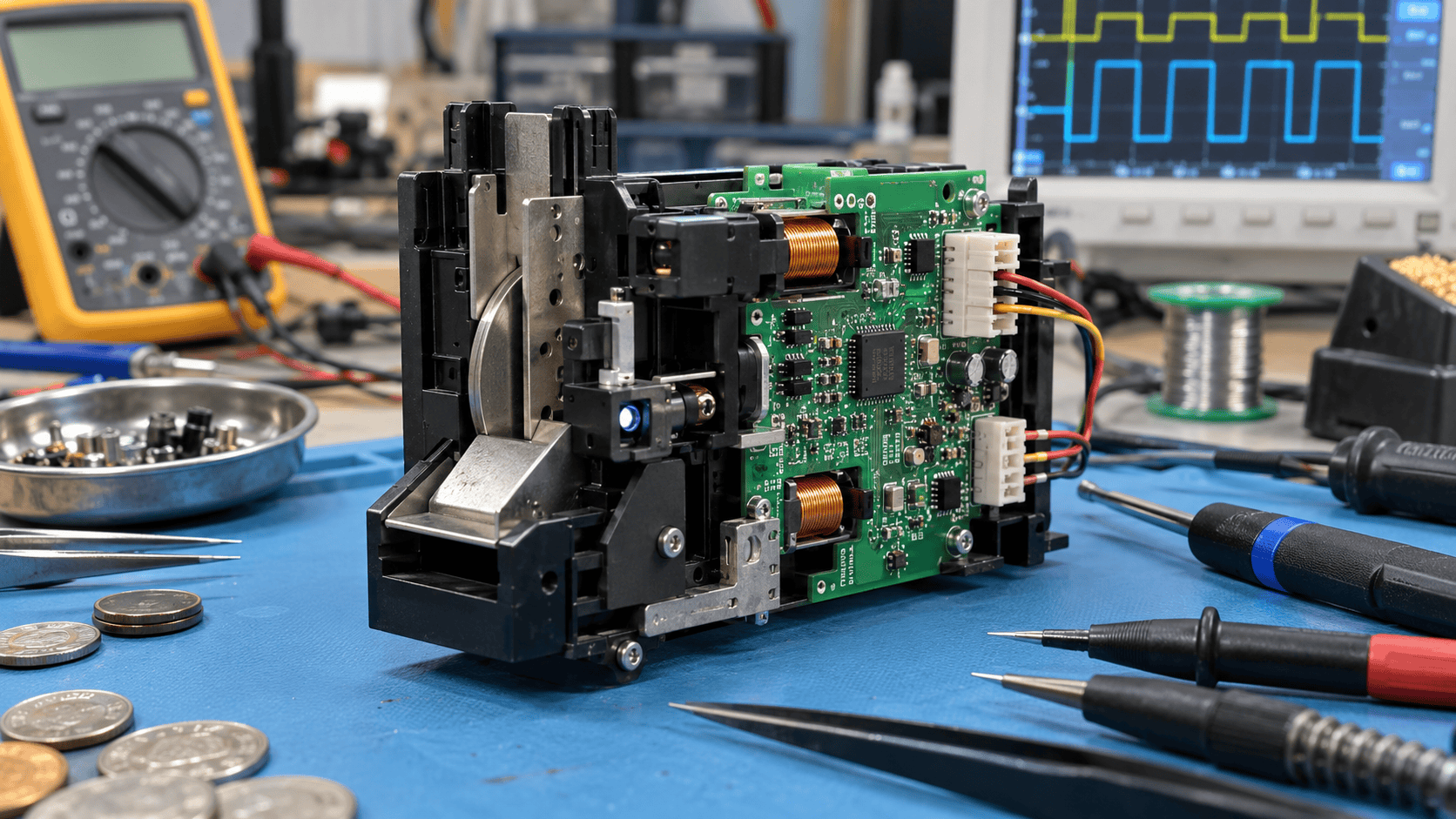
Vending Machine Coin Validator Repair in Cornwall
A vending machine can appear healthy while repeatedly rejecting genuine coins, failing to register credit or reporting a payment mechanism fault. The cause may lie in the coin validator rather than the machine’s main controller. At Cornwall Electronic Repairs, we can assess the electronic circuitry in suitable coin validators and investigate whether a component-level repair is technically and economically practical.
Coin validators are precision payment devices. Their optical, electromagnetic and electronic sensing systems must distinguish accepted coins from unsuitable objects. An electronic repair therefore needs more than a replacement part: the mechanism must still recognise denominations reliably and reject invalid payments.
How Electronic Coin Validators Work
Many modern validators guide each coin through a defined path past several sensors. Depending on the design, these can include inductive coils, optical detectors and circuits that examine the coin’s electrical and physical characteristics. A microcontroller processes the resulting signals and determines whether to accept or return the coin.
Once a coin is accepted, the validator communicates credit information to the host vending machine. Interfaces vary by model and may include pulse outputs, serial communications or MDB (Multi-Drop Bus). The validator also needs stable power, intact connectors and suitable configuration data.
A problem anywhere in that chain can cause a payment failure, although dirt, mechanical wear or incorrect configuration may produce similar symptoms without a failed PCB.
Faults We Can Investigate
Coins Rejected or Credit Not Recorded
If genuine coins are consistently rejected, we can investigate sensor supply rails, signal-conditioning circuits, connectors and evidence of electrical damage. Where suitable technical information and test facilities are available, we can compare signal behaviour as a coin passes the sensing area.
A validator that accepts coins but fails to register credit may instead have an output-stage, interface or host-connection fault. We would first establish which part of the system is responsible rather than assume that its circuit board has failed.
Intermittent Operation and Power Faults
Intermittent resets, erratic operation or a completely unresponsive validator can point towards unstable supply voltages, defective regulators, damaged connectors or deteriorated solder joints. Assessment may include current-limited power testing, voltage measurements and targeted oscilloscope checks on relevant circuits.
We can also inspect for moisture damage, corrosion, cracked solder joints and components affected by overheating. These observations help determine whether a repair attempt is justified.
Sensor and Communication Problems
Optical sensing can be disrupted by contamination, misalignment or an electrical fault in the emitter or receiver circuit. Inductive sensing depends on intact coils and associated analogue electronics. If the validator reports communication errors, we can consider interface protection components, transceivers and continuity between the board and its external connector.
Testing must follow the particular model’s specifications. A general-purpose bench test cannot prove that every coin-recognition or anti-fraud function works correctly.
Our Electronic Assessment Approach
1. Identify the Mechanism and Symptoms
We would ask for the manufacturer, model, supply rating, photographs and a clear description of the fault. Details about the host machine, accepted coin denominations and any error messages may help narrow the investigation. Where practical, the validator should arrive with the relevant connecting loom or interface information.
2. Inspect and Test the PCB
With power disconnected, an initial inspection can reveal damaged tracks, liquid ingress, failed components or suspicious previous repairs. Depending on accessibility and design, we may check passive components, supply rails and semiconductor junctions before applying controlled power.
Where the fault justifies further investigation, a bench power supply, multimeter or oscilloscope can help trace voltage instability, missing drive signals or abnormal sensor responses. We avoid injecting signals or substituting components without understanding the risk to connected logic and calibration.
3. Consider Repair and Verification
If we locate an identifiable electrical fault and compatible parts are obtainable, component replacement or carefully controlled solder rework may be possible. We would then repeat relevant electrical checks and explain any remaining limitations.
Full verification may require the original vending machine, appropriate interface test equipment, known-good coins and manufacturer-approved calibration procedures. Without these, we cannot claim that a repaired validator will meet payment accuracy or fraud-resistance requirements in service.
When Repair May Not Be Sensible
Coin validators can contain locked firmware, encrypted configuration, programmed sensor data or factory-calibrated assemblies. These are not necessarily recoverable through normal PCB repair. Worn coin paths, damaged precision sensors or obsolete proprietary parts may also make replacement more practical.
Commercial operators should consider the validator’s age, replacement price, downtime and the consequences of accepting or rejecting payments incorrectly. We do not offer unauthorised firmware modification, security bypasses or changes to coin acceptance criteria. Any repaired payment mechanism should undergo suitable operational testing before returning to unattended use.
Request an Electronic Repair Assessment
If you have a faulty vending machine coin validator, Cornwall Electronic Repairs can review the model and symptoms and advise whether an electronic assessment is appropriate. An assessment does not guarantee that repair will be possible, and we would discuss the findings before any further work is agreed.
Request a repair assessment and include the model number, fault description and photographs where available.