
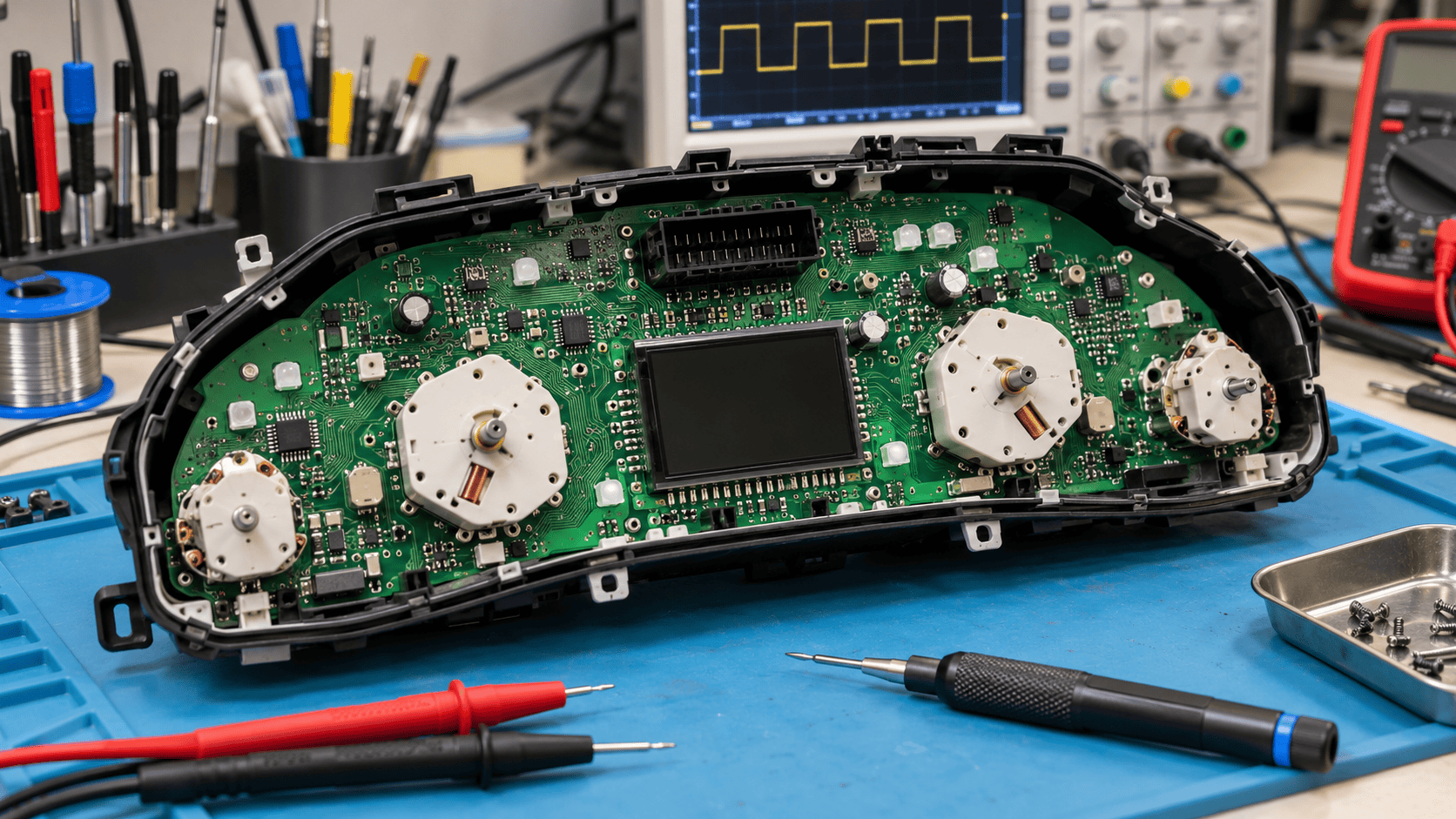
Vehicle Instrument Cluster Repair in Cornwall: Electronic Fault Assessment
A vehicle instrument cluster brings together speed, engine information, warning indicators and, on many models, a digital display. When the cluster develops an electronic fault, the symptoms can range from missing display segments to gauges that behave unpredictably. Cornwall Electronic Repairs can assess certain removable instrument clusters and investigate whether a component-level repair is technically and economically practical.
This is an assessment-led service, not a promise that every cluster can be repaired. Vehicle-specific coding, calibration and safety requirements can determine what work is appropriate.
Common instrument cluster faults
A faulty cluster may show one or more of these symptoms:
- A display that is blank, dim, flickering or missing segments.
- Gauges that stop responding, move erratically or remain at an incorrect position.
- Intermittent loss of illumination or a complete loss of cluster power.
- A cluster that resets, switches off or restarts without warning.
- Warning indicators that fail to illuminate during the normal self-check.
- Signs of moisture ingress, connector damage or previous unsuccessful soldering work.
These symptoms do not always establish that the cluster itself is defective. Supply faults, wiring, sensors, network communication or another vehicle module may produce similar behaviour. Diagnosing the source correctly avoids unnecessary board replacement.
What happens during an electronic assessment?
Initial inspection and fault history
We start with the exact make, model, part number and a clear description of the reported behaviour. Photographs or a short video can help document intermittent faults. We also ask whether a vehicle diagnostic scan has identified relevant communication or supply faults.
Once a suitable cluster arrives at the workshop, we inspect its enclosure, connectors and PCB for corrosion, impact damage, heat stress, fractured solder joints and evidence of earlier repairs. We record the board condition before deciding whether further testing is justified.
Power supply and circuit checks
Where reliable pinout information and safe test conditions are available, we may check supply inputs, ground continuity, protective devices and onboard voltage regulation. A laboratory power supply with current limiting can help identify abnormal current consumption without immediately exposing the assembly to an unrestricted supply.
A multimeter and oscilloscope may help investigate unstable regulator outputs, reset lines, oscillator activity or intermittent connections. Testing must follow the particular cluster design; applying power to unidentified pins can permanently damage electronics.
Displays, illumination and gauge electronics
If evidence points towards the cluster PCB, we can examine display connectors, soldered joints, backlight drive circuitry and accessible gauge-driver components. Magnified inspection may reveal cracked joints or corrosion around fine-pitch components.
A display fault may instead involve a bonded ribbon, proprietary LCD, specialised motor or unavailable module. Replacing a single component is not always possible, and a visually damaged component does not necessarily explain the original symptom.
Vehicle networks, coding and important limitations
Modern clusters often communicate over CAN or other vehicle networks. An apparently dead dashboard can be responding to a missing network message rather than suffering an internal electronic failure. Bench testing may therefore confirm only part of the unit’s functionality, particularly without the original vehicle and manufacturer-specific diagnostic equipment.
Some clusters also participate in immobiliser, key or vehicle configuration functions. Cornwall Electronic Repairs does not offer odometer alteration, mileage correction, security bypassing or unauthorised immobiliser programming. We will not change recorded mileage or vehicle identity data as part of an electronic fault assessment.
Speed indication, tell-tales and warning lamps have direct road-safety implications. A cluster that appears to operate on the bench still needs appropriate vehicle-level checks and, where necessary, specialist coding or calibration before it can be relied upon. Do not drive a vehicle with essential instruments or warning functions inoperative.
Can a faulty instrument cluster PCB be repaired?
Potentially repairable defects may include a failed accessible voltage regulator, damaged connector, localised corrosion or fractured solder joint. Any proposed repair depends on proving the fault and confirming that suitable parts and methods are available.
We assess whether the board has multilayer damage, proprietary programmed devices, inaccessible assemblies or extensive contamination. Such conditions can make a reliable repair uneconomic or impractical. We also consider replacement-cluster availability, the cost of specialist programming and the risk that another vehicle system caused the reported symptoms.
After the initial assessment, we can explain our findings and discuss whether further work is worthwhile. If we cannot establish a safe and credible repair route, we will say so rather than replace components speculatively.
Before sending your instrument cluster
Please contact us before removing or posting a cluster. Include the vehicle make, model and year, the cluster’s manufacturer or part number, the symptoms and any relevant diagnostic fault codes. Tell us about water exposure, jump-starting incidents or previous repair attempts.
Removal should follow the manufacturer’s procedure. Disconnecting vehicle electronics incorrectly can introduce further faults, and modern vehicles may require specialist handling or subsequent configuration. We assess suitable detached assemblies at the workshop; we do not present this service as a complete in-vehicle diagnostic or coding service.
Request an electronic repair assessment
Cornwall Electronic Repairs offers a £40 initial assessment for suitable electronic equipment. We examine the reported fault and advise on possible next steps before any separately authorised repair work proceeds. Parts availability, testing limitations and overall cost may mean repair is not recommended.
If your vehicle instrument cluster has developed a suspected electronic fault, send a repair enquiry with its identification details and a description of the problem. We can then advise whether the unit is suitable for workshop assessment.