
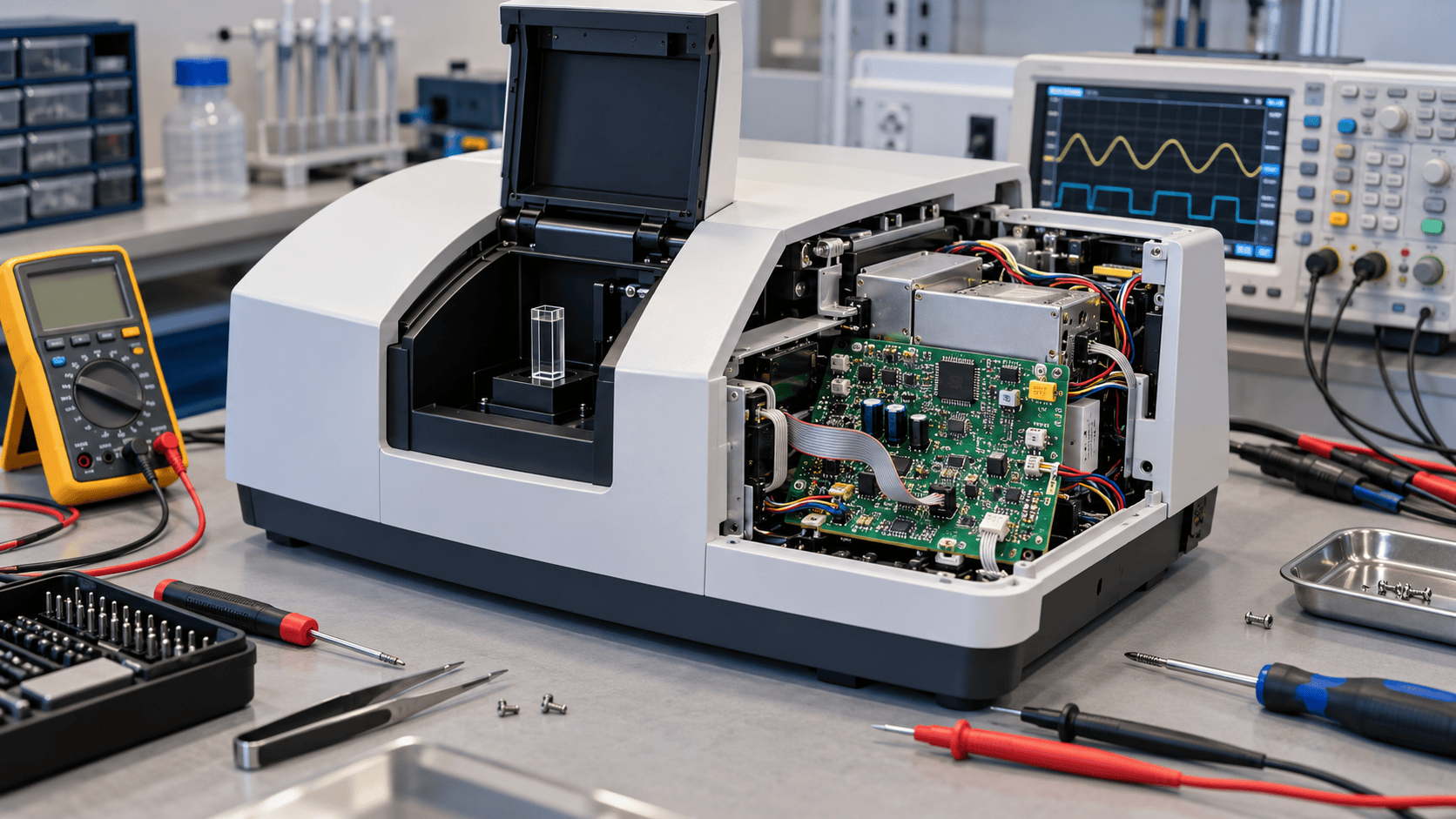
Laboratory Spectrophotometer Electronics Repair in Cornwall
Cornwall Electronic Repairs (CER) can assess selected laboratory spectrophotometers for faults in their electronic assemblies. We focus on evidence-led fault diagnosis, practical component-level investigation and an honest appraisal of whether repair is technically and economically sensible. Assessment does not imply that every instrument can be repaired or returned to calibrated service.
Laboratory spectrophotometers measure how much light a sample absorbs or transmits at selected wavelengths. They depend on stable light sources, sensitive detectors, control electronics and, in some instruments, precisely positioned optical components. When readings become unreliable or an instrument stops operating, an electronic fault may be responsible, but the cause needs investigation rather than assumption.
Which spectrophotometers might be suitable?
Enquiries may involve benchtop visible-light or ultraviolet-visible (UV-Vis) spectrophotometers used in education, research and routine laboratory work. Depending on the design, the equipment may use a tungsten-halogen lamp, a deuterium UV source, LEDs or another light source. Detector arrangements also vary, from individual photodiodes to diode arrays.
The make, model, age, fault symptoms and availability of technical information affect what CER can investigate. Some instruments have sealed optical modules, manufacturer-only parts or service restrictions. We review those limitations before recommending that equipment be sent to the workshop.
Common symptoms worth investigating
Failure to start or complete self-tests
A spectrophotometer that remains dead, restarts repeatedly or displays an error during its initial checks may have a problem with its power supply, control board, connectors or a monitored subsystem. An error code can narrow the investigation, but it does not prove that a particular circuit board has failed.
Unstable readings or unexpected baseline drift
Fluctuating absorbance values, excessive noise and a drifting baseline can arise from the lamp, detector, analogue signal chain, supply rails, temperature changes or optical contamination. CER can consider electronic causes while recognising that sample preparation and optical condition can produce similar symptoms.
Lamp, detector and control faults
Certain instruments report low light energy, lamp ignition failures, detector errors or communication problems. Depending on access and documentation, potential investigation areas include lamp-drive electronics, detector supply and amplifier stages, internal ribbon connections and digital control interfaces. Lamp and detector replacement may require specialist procedures or parts that CER cannot supply.
How CER approaches an electronic assessment
Initial review and non-powered checks
We first review the instrument identification, its reported behaviour and any available service material. Following safe isolation, inspection may reveal damaged connectors, corrosion, heat-stressed components, cracked solder joints or previous repair work. Where appropriate, resistance, semiconductor and continuity measurements help establish whether an electrical fault is plausible.
Controlled testing of electronic assemblies
Where access and safety permit, we may measure regulated supply voltages, assess ripple and switching behaviour with an oscilloscope, and examine relevant control or detector signals. Fault tracing can involve checking regulator stages, protection components, operational amplifiers and connections between assemblies. Measurements depend on the actual circuit design; no universal set of voltages or test points applies to every spectrophotometer.
Sensitive detector outputs may sit at very low signal levels. Probing them carelessly can introduce noise or damage an input stage, so testing must suit the instrument’s architecture. Similarly, a communication fault should be distinguished from a failed detector or light source before parts are ordered.
Repair feasibility and reporting
If a failed electronic component or connection can be identified, CER can consider a suitable repair and subsequent functional checks. A proprietary processor, unavailable optical module, inaccessible assembly or extensive damage may make repair impractical. We explain findings and seek authorisation before proceeding beyond the agreed assessment.
Safety, calibration and performance limitations
UV-Vis equipment can contain hazardous mains voltages, charged capacitors, hot lamps and ultraviolet radiation. Some lamp systems use high-voltage ignition circuits. We do not recommend that customers open the equipment or bypass protective covers and interlocks. Instruments previously exposed to hazardous chemicals must be professionally decontaminated and declared safe before acceptance.
An electronic repair is not the same as spectrophotometer calibration. Reliable analytical use may require wavelength accuracy checks, photometric verification, stray-light testing and traceable reference standards. CER does not claim accredited calibration or automatic restoration of manufacturer specifications. Where validated performance is essential, particularly for regulated laboratory work, an appropriately equipped specialist or the manufacturer must undertake the required verification before the instrument returns to service.
Is repair economical?
The likely cost depends on the fault, time needed to reach the suspect circuit, replacement-part availability and the value of the instrument. Older laboratory equipment may justify investigation when replacement is expensive or compatibility with established workflows matters. Conversely, a low-value instrument with a sealed optical system or unobtainable parts may not warrant extensive work.
CER’s standard assessment fee is £40. After evaluation, we can explain whether further electronic investigation is worthwhile, whether specialist calibration would still be required and what limitations remain. We cannot promise a successful repair before diagnosis.
Request an assessment in Cornwall
If your laboratory spectrophotometer has stopped working, fails its checks or produces unstable readings, please provide its manufacturer, model, symptoms and relevant error messages. Mention any chemical exposure, prior repair attempts and whether your work requires certified calibration. Do not ship an instrument until its suitability and safe handling have been discussed.
Request a repair assessment to ask whether Cornwall Electronic Repairs can investigate the electronics in your spectrophotometer.