
Pet Microchip Scanner Repair in Cornwall: Electronic Fault Assessment
Pet microchip scanners help veterinary practices, animal rescues and other authorised users identify animals from implanted transponders. A handheld reader may appear simple, but reliable operation depends on several electronic stages working together. Cornwall Electronic Repairs can assess faults in suitable scanners, investigate their electronics and determine whether a practical component-level repair may be possible.
We do not assume that every scanner is economical or safe to repair. The assessment starts with the make, model, reported symptoms and the availability of suitable test information.
How a pet microchip scanner works
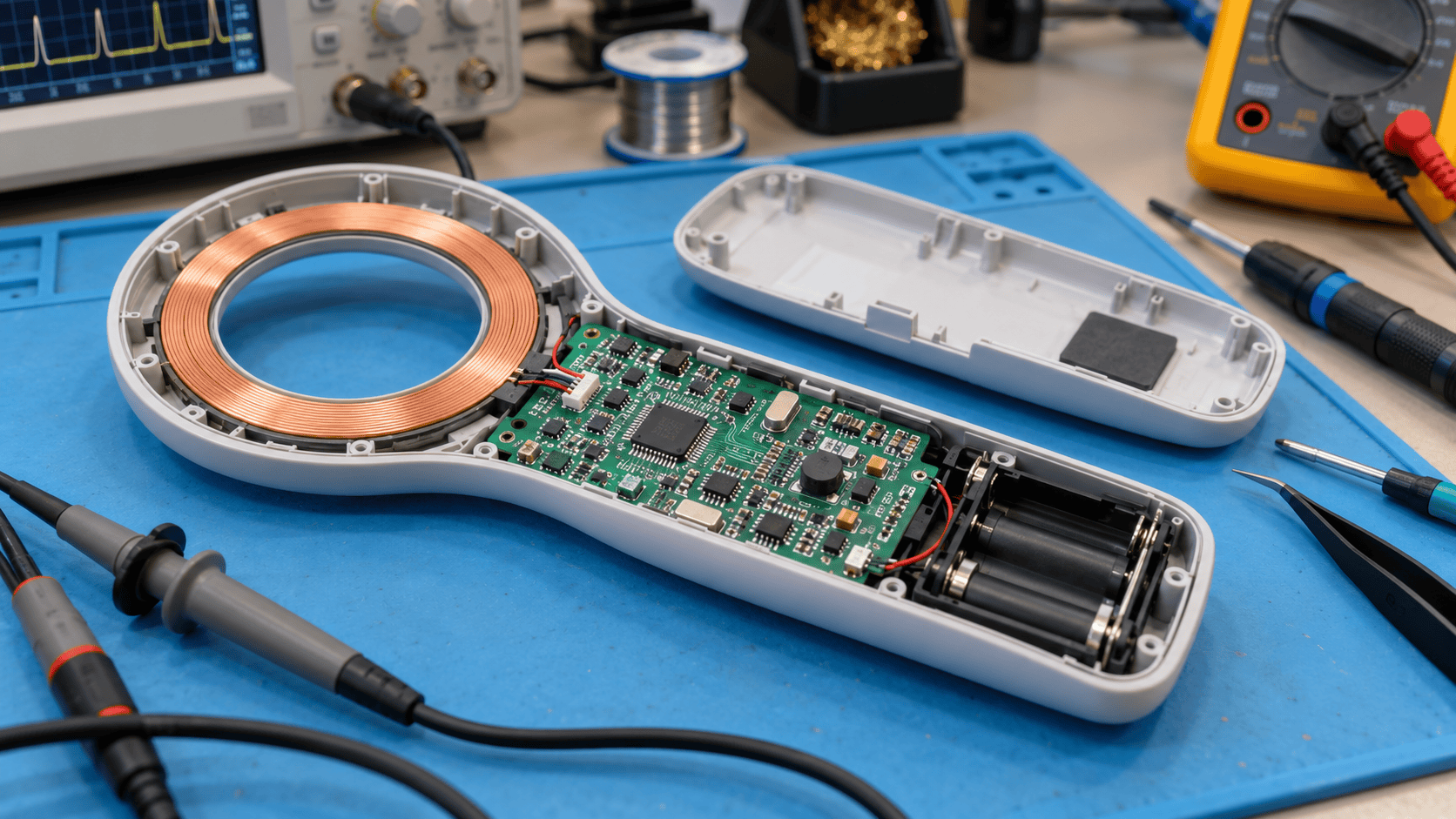
Most conventional animal identification readers energise a passive microchip using a low-frequency magnetic field, commonly around 134.2 kHz for ISO-compatible systems. The scanner’s antenna coil creates the field, while its receiving circuitry detects and decodes the transponder response. Control electronics then present the identification number on a display or transfer it through a supported interface.
The complete signal path may include battery management, voltage regulation, a microcontroller, oscillator and drive circuitry, an antenna matching network, sensitive receiver stages and the user interface. A fault anywhere along that path can prevent a valid reading.
Symptoms that warrant electronic investigation
A scanner may fail to power on, restart unexpectedly or discharge its battery unusually quickly. Other units power up normally but cannot read a compatible microchip, read only at very short range or behave intermittently when the housing or cable moves.
Some faults affect charging, the display, buttons, audible indication or data transfer rather than microchip detection itself. Environmental exposure, dropped equipment, worn connectors and previous attempted repairs may also influence the assessment.
Not every failed scan indicates damaged electronics. Transponder type, orientation, scanning technique, nearby electrical interference and the animal’s chip position can all affect reading performance. Establishing the operating conditions helps avoid replacing working parts.
What Cornwall Electronic Repairs can examine
Power supply, battery and charging circuits
Where access is practical, we can check supply polarity, input protection, connector condition, battery contacts, voltage rails and excessive current consumption. A scanner that starts and immediately resets may have a weak supply, an intermittent connection or a fault that appears only when the RF transmitter is active.
Rechargeable battery packs require particular care. Swollen, damaged or suspect lithium cells must not undergo experimental charging. Any replacement needs an appropriate specification and protection arrangement; a superficially similar cell is not necessarily a safe substitute.
Antenna and RFID signal path
An open antenna winding, fractured solder joint or damaged connector can interrupt the magnetic field required to interrogate a transponder. Assessment may involve checking coil continuity, associated components and the drive waveform with suitable instruments.
The receiving stage can be more difficult to evaluate. Low-level signals, resonant networks and timing-sensitive decoding require careful probing to avoid disturbing normal operation. We may investigate accessible analogue stages and board-level faults, but proprietary integrated circuits or unavailable design information can limit how far diagnosis can proceed.
Buttons, displays and internal connections
Physical inspection may reveal cracked joints, corrosion, damaged flexible cables or failed switches. We can inspect accessible PCB connections under magnification and test suspect components where appropriate. Display modules, membrane keypads and custom parts are only repairable or replaceable when suitable parts and access exist.
How the assessment is approached
The first stage is to confirm the reported behaviour and record the scanner’s condition. Where possible, controlled checks compare power consumption, supply stability and basic user-interface operation. We then narrow the investigation to the relevant circuitry rather than replacing components speculatively.
For scan-related faults, testing against a known-compatible reference transponder may help distinguish reader failure from chip compatibility or technique. A valid read of one tag does not prove compliance with every supported protocol or guarantee full operating range. Any post-repair functional checks must reflect the equipment’s intended use and the test resources available.
We do not bypass manufacturer security, alter identification data or claim certification of RFID performance. Where calibration, formal conformity testing or manufacturer-specific diagnostics are necessary, referral or replacement may be more appropriate.
Is repair economically worthwhile?
A repair assessment considers the scanner’s value, replacement cost, fault severity, available parts and expected labour. Common connection faults may justify investigation, while a damaged custom processor, sealed assembly or unobtainable antenna module may make repair uneconomic.
We explain findings and potential options before proceeding with additional authorised work. An assessment does not guarantee a repair outcome, and some faults cannot be confirmed without specialist accessories, service data or a representative transponder.
Request a pet microchip scanner assessment
Cornwall Electronic Repairs welcomes enquiries about suitable handheld pet microchip scanners from veterinary practices, animal charities and private owners. When contacting us, provide the manufacturer and model, power or charging arrangement, symptoms, any error messages and whether the fault started after impact or moisture exposure. Please do not send an animal or implanted transponder.
Use our Request a Repair page to describe the equipment and proposed assessment. We can review the enquiry and advise whether the scanner appears suitable for further investigat