
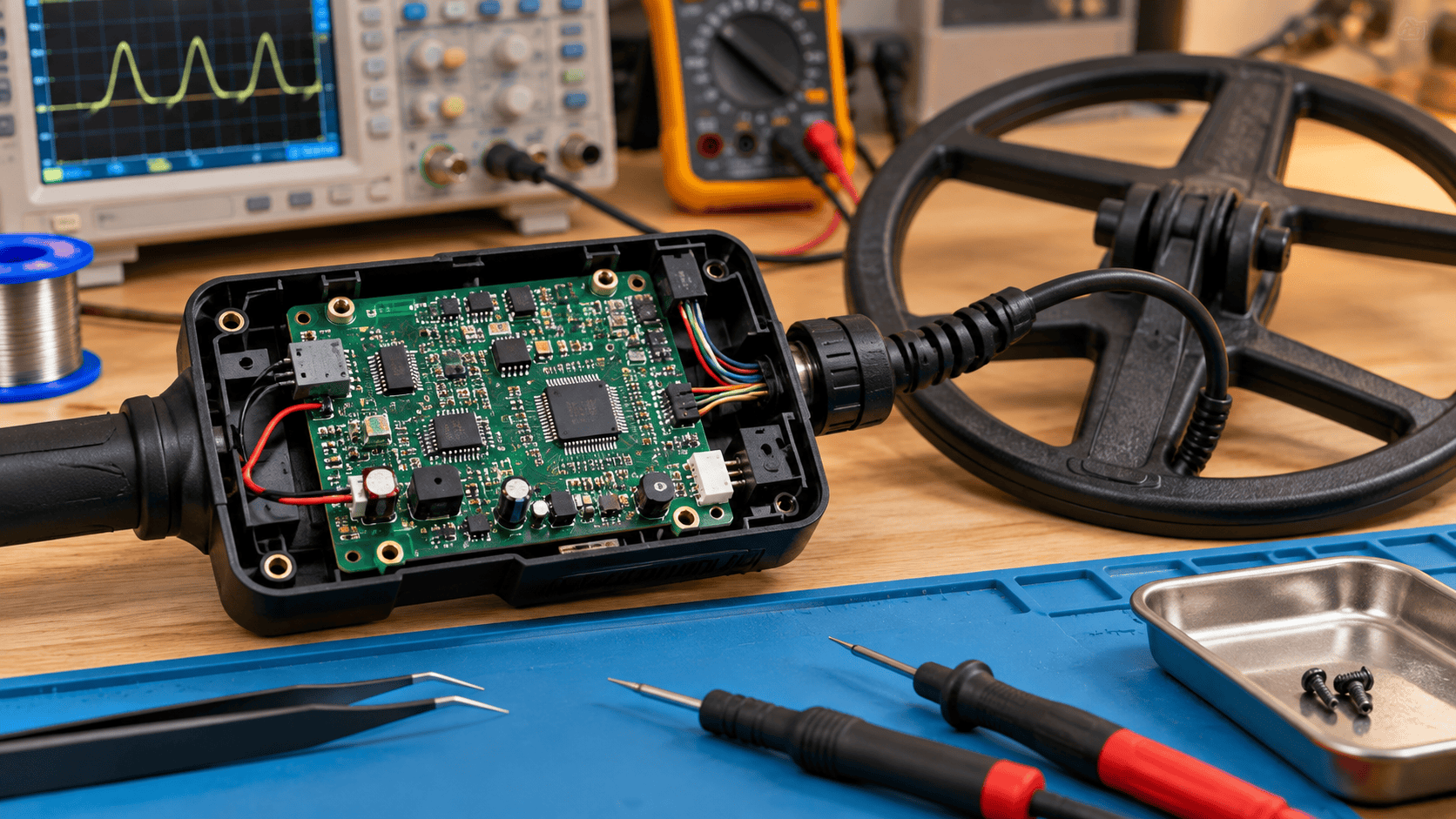
Metal Detector Electronics Repair in Cornwall: Fault Diagnosis and Assessment
A metal detector that stops responding, behaves erratically or refuses to power on may have an electronic fault rather than a problem with its search settings. Cornwall Electronic Repairs can assess suitable metal detector control units, search-coil connections and associated circuitry to determine whether a practical metal detector electronics repair may be possible.
Modern detectors combine sensitive analogue measurements with digital signal processing. This makes systematic fault finding important: an unstable response can arise from the coil, its cable, power circuitry, external interference or the control electronics. Replacing parts without establishing the cause can introduce further problems.
Metal Detector Faults Worth Investigating
Equipment may merit an assessment when it develops symptoms such as:
- Failure to power up despite known-good batteries or the correct external supply.
- Intermittent operation when the control housing or coil cable moves.
- Repeated resets, unexpected shutdowns or unusually short battery life.
- Erratic target indications that persist after sensible sensitivity and interference checks.
- Missing audio, unresponsive buttons or a blank or unstable screen.
- Coil detection errors, poor connector contact or visible moisture damage.
These symptoms do not establish that a circuit board is defective. Incorrect settings, electromagnetic interference, damaged coil windings and battery problems can produce similar behaviour. An assessment begins by separating these possibilities.
How We Can Assess Metal Detector Electronics
Power and Battery Connections
Where the design allows safe access, we can inspect battery terminals, wiring, switches and supply connectors for corrosion, mechanical damage or excessive resistance. Controlled measurements may help identify abnormal current consumption, an open protective device or a missing regulated voltage.
Some detectors use rechargeable lithium batteries inside sealed assemblies. We do not bypass battery protection or attempt unsafe charging tests. A swollen, damaged or suspect battery requires appropriate handling, and specialist battery replacement may be preferable to board-level work.
Search-Coil Cable and Connector Faults
The search coil and control unit form a sensitive measurement system. Repeated flexing can damage a cable near the coil entry, strain relief or plug, while contamination may compromise connector contacts.
We can inspect accessible connectors and, where suitable information is available, check continuity and relevant electrical characteristics without stressing the coil or its interface. A simple resistance reading alone cannot establish that a search coil is fully serviceable. Its inductance, shielding, internal connections and behaviour at operating frequencies may also matter.
Control PCB and Signal Path
With a suitable unit, PCB inspection under magnification can reveal cracked joints, liquid residue, damaged connectors, failed protection components or signs of localised overheating. Targeted testing may include voltage measurements, continuity checks and oscilloscope examination of accessible signals.
A detector’s transmit and receive circuitry may work with small signals that are readily disturbed by inappropriate probing. We select test methods cautiously and avoid applying test signals to unknown inputs. Firmware-dependent processing and proprietary integrated circuits can also restrict what independent component-level diagnosis can establish.
Buttons, Audio and Display Functions
An apparently dead detector may still have functioning processing electronics but a faulty power switch, keypad, display connection or audio output stage. Accessible controls, contact assemblies and signal paths can be examined to distinguish a local hardware defect from a wider electronic failure.
What Determines Whether Repair Is Viable?
Not every metal detector can be opened or repaired economically. Many newer models use sealed housings, bonded construction, multilayer PCBs or manufacturer-specific components. Water-resistant equipment presents an additional challenge: opening a housing can compromise its original sealing, and a general electronic repair does not automatically restore the manufacturer’s ingress-protection rating.
Repair feasibility depends on component availability, board condition, access to meaningful test points, the extent of corrosion and the value of the detector. A manufacturer may be better placed to address firmware faults, coded replacement modules, search-coil calibration or faults requiring dedicated alignment equipment.
Even when an electronic fault can be located, confirming full target-identification accuracy and field performance may require facilities or reference equipment that are unavailable for a particular model. Any limitations should be explained before a repair proceeds.
Preparing a Metal Detector for Assessment
Please provide the manufacturer and model, a clear description of the fault, and when it occurs. Mention any immersion, battery leakage, impact or previous repair attempts. Photographs of the control unit, connectors and affected areas can help with initial triage.
If practical, explain whether you have already tried fresh approved batteries, checked the settings and tested away from strong electrical interference. Do not open a waterproof housing or dismantle a lithium battery pack simply to prepare an enquiry.
Before sending equipment, contact us to confirm whether we can assess the particular model and which accessories are needed. Depending on the symptoms, we may request the compatible search coil, cable or power supply so that the relevant interfaces can be examined.
Request a Metal Detector Electronics Repair Assessment
Cornwall Electronic Repairs focuses on identifying the cause of faults and establishing whether a safe, proportionate component-level repair is realistic. Our standard assessment fee is £40. We explain findings and proposed next steps before any additional repair work is authorised. An assessment does not guarantee that a fault can be reproduced or repaired.
If your metal detector has developed an electronic problem, then contact us with its model details and symptoms. We can then advise whether the equipment is suitable for assessment before you arrange delivery.