
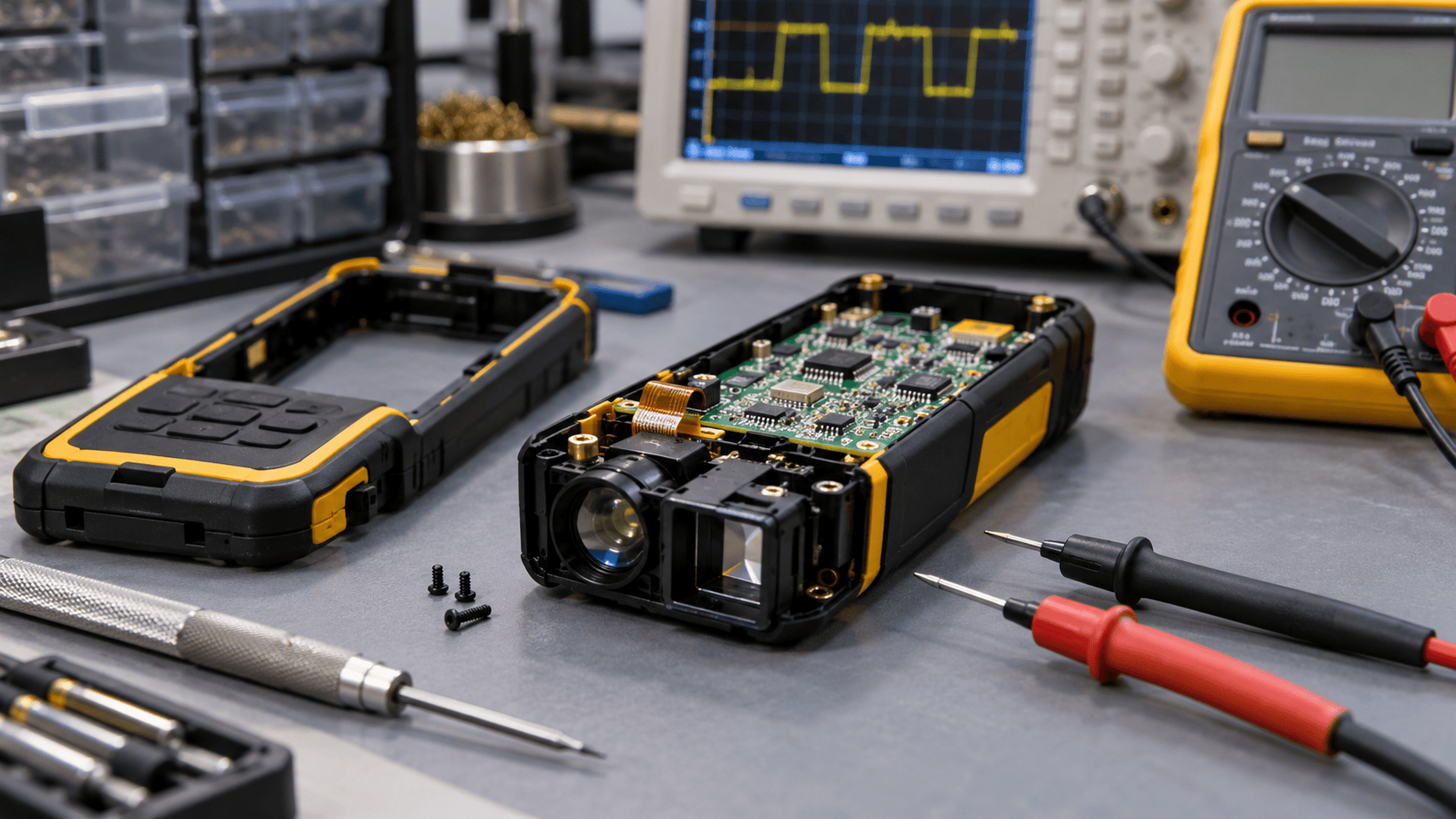
Laser Distance Meter Repair in Cornwall: Electronic Fault Assessment
Cornwall Electronic Repairs can assess suitable laser distance meters, investigate electronic faults and consider component-level repairs where the design and available parts allow. We support enquiries from Cornwall and elsewhere in the UK through an agreed postal assessment process. An assessment establishes possibilities; it does not guarantee a successful repair or restore certified measurement accuracy.
Handheld laser distance meters help surveyors, builders, installers and maintenance engineers measure distances quickly. These compact instruments combine a laser emitter, an optical receiver, timing or phase-measurement electronics, processing circuitry and a display. When a meter develops a fault, replacing the entire instrument may not always make economic sense, particularly for a professional model.
Common Laser Distance Meter Faults
A meter may fail completely, restart unexpectedly or refuse to take a reading. Other symptoms include intermittent buttons, a blank screen, unusually short battery life and charging or battery-contact problems. Some instruments power up normally but show measurement errors, a laser warning or an inability to obtain a return signal.
These symptoms have different possible causes. A dark display does not necessarily mean the screen has failed, and a meter that cannot measure does not automatically have a defective laser. Environmental conditions, contaminated optics, weak batteries and incorrect operating settings can affect performance before any component fails.
Power, Battery and Switching Problems
The first checks focus on the power source and its connections. An engineer can inspect battery terminals for contamination, assess spring contact pressure and check for abnormal current consumption. Where circuit access permits, voltage measurements can help identify short circuits, unstable regulators, damaged protection devices or poor solder joints.
Some meters use rechargeable lithium-ion cells. Battery work demands suitable handling and protection arrangements. We would not bypass a protective circuit or fit an incompatible cell simply to make the instrument switch on.
Buttons, Display and Internal Connections
Repeated use can wear button contacts, damage flexible interconnects or stress solder joints. Moisture ingress and impact can introduce further faults. A controlled inspection may reveal cracked joints, loose connectors, corrosion or damaged PCB tracks.
Depending on the construction, Cornwall Electronic Repairs may assess switches and accessible electronic connections. Bonded displays, custom membrane keypads and proprietary flex assemblies can make replacement impractical even when fault diagnosis identifies the affected part.
How We Investigate Electronic Faults
We begin by identifying the manufacturer, model and exact symptoms. We also ask whether the meter suffered a drop, exposure to moisture or an earlier repair attempt. That history helps us choose checks without making assumptions about the cause.
After a visual inspection, appropriate bench investigation may include checking supply rails, measuring current draw, examining semiconductor devices and testing relevant signals with an oscilloscope. Where practical, we can compare behaviour across standby, startup and measurement modes. We assess any visible contamination or heat damage before applying further power.
We do not probe live laser-driver circuitry casually. An instrument may contain fast pulses, sensitive receiver stages and optical assemblies that require specialised procedures. Circuit documentation can be limited, and dense surface-mount construction may restrict access. We assess those constraints before attempting component removal or board rework.
Optical Faults and Measurement Accuracy
The optical system presents a separate challenge. A laser distance meter relies on correct alignment and signal processing, not merely a functioning light source. A cracked lens, displaced optical component or damaged emitter can prevent measurement even when the main PCB works.
Opening an optical assembly can change its alignment. A replacement laser component must meet the original design requirements, including output and safety classification. We will not increase laser output, defeat an interlock or make an undocumented optical modification to force a reading.
Electronic repair also differs from metrological calibration. A unit that powers up and displays measurements may still be inaccurate. If a repair affects the measurement path, the instrument may need manufacturer procedures, traceable calibration or independent verification before professional use. We would discuss those requirements and any limits on our available test equipment before proceeding.
When Is Repair Economically Sensible?
Cost matters. A basic consumer meter may cost less to replace than to diagnose and rebuild. A higher-value professional instrument can justify investigation if the fault involves an accessible connection, power circuit, switch or replaceable component. Proprietary integrated circuits, optical modules and unavailable displays can quickly change that calculation.
Our standard assessment fee is £40. Following assessment, we can explain the findings, identify any practical next steps and provide a repair quotation where appropriate. We seek authorisation before additional chargeable work. Sometimes the assessment will show that repair is technically uncertain, unsafe or uneconomic; in those cases, we will explain the limitation rather than promise a result.
Request a Laser Distance Meter Assessment
If your laser distance meter has stopped working, tell us the make, model and symptoms. Please mention any damage, previous repairs and whether you need formal calibration or accuracy certification after the work. Photographs can help us judge the likely scope before you send anything.
Request a repair assessment with Cornwall Electronic Repairs. We will review whether the equipment suits our assessment service and explain the next steps. Please do not send the instrument until we have agreed the arrangements.