
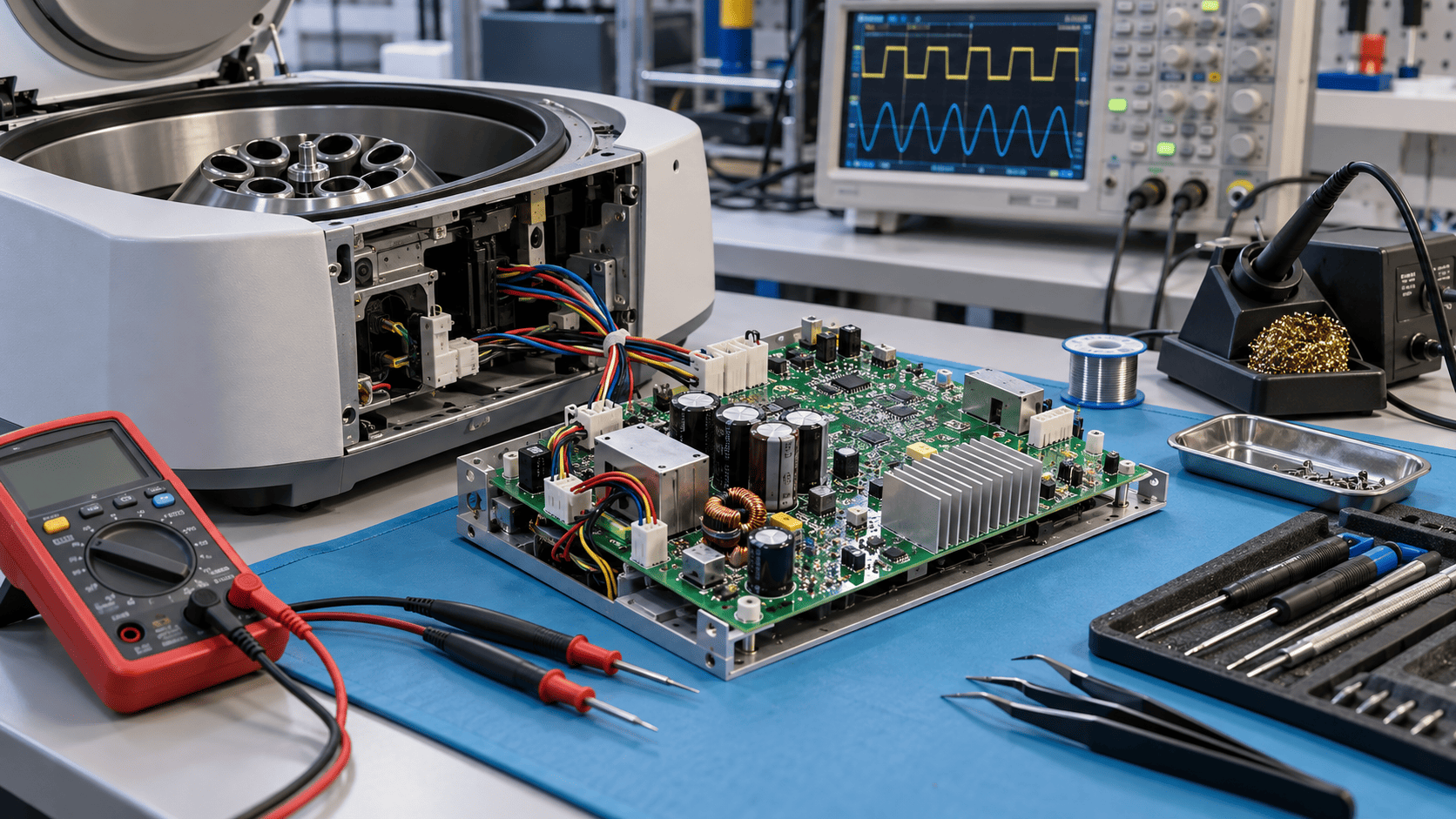
Laboratory Centrifuge Electronics Repair in Cornwall
Cornwall Electronic Repairs can assess certain electronic faults in laboratory centrifuges, including power supply boards, control PCBs and associated electrical connections. Any investigation depends on the instrument’s construction, condition, available technical information and the safety implications of the reported fault.
Laboratory centrifuges rely on precise electronic control to accelerate, monitor and stop a rotating assembly safely. When a benchtop centrifuge fails to start, reports a speed error or behaves unpredictably, the cause may lie in its control electronics rather than the motor or rotor itself.
Common Laboratory Centrifuge Electronic Faults
A centrifuge may illuminate its control panel without starting a programme. Another instrument may fail completely, reset unexpectedly or stop with an error message. These symptoms provide useful clues, but they do not identify a failed component on their own.
Potential electronic problems include unstable low-voltage supplies, damaged connectors, deteriorated solder joints, defective switching components and faults within motor-control circuitry. Speed feedback from a Hall-effect sensor, optical pickup or encoder may also be missing or inconsistent, depending on the model.
A lid-closed indication that fails to register could involve wiring, a switch, a sensor or its interface circuit. However, an interlock error must never be treated as an inconvenience to bypass. It may indicate a critical safety function that requires manufacturer-approved servicing.
How We Approach Electronic Fault Diagnosis
Initial Assessment and Visual Inspection
The first stage is to establish the make, model, reported behaviour and any relevant fault codes. We also need to know whether the instrument has suffered liquid ingress, overheating or an electrical incident. Laboratory users should arrange suitable cleaning and provide confirmation of decontamination before equipment is accepted for examination.
With the equipment disconnected and made safe, an inspection may reveal heat-discoloured areas, damaged wiring, corrosion, loose connectors or fractured solder joints. Visible damage is useful evidence, although an apparently clean board can still contain an electrical fault.
Power Supply and Control PCB Checks
Where access and design permit, we can examine input protection, rectification, voltage regulation and the distribution of power to the control board. A supply that measures correctly without load may still collapse when other circuitry starts operating.
Tests may include continuity and resistance measurements, checks for short circuits, capacitor assessment and inspection of semiconductor devices. Appropriate current-limited methods can help distinguish a defective supply rail from a downstream load. Oscilloscope measurements may provide further information about ripple, start-up behaviour or control signals, where safe and technically justified.
Motor Drive and Speed Feedback Circuits
Some centrifuges use electronic motor drives with power semiconductors, drive stages and speed-sensing feedback. These sections may warrant examination if the controls respond but the motor fails to accelerate, or if a speed-related error occurs.
The investigation must distinguish an electronic control fault from mechanical resistance, motor damage or an unsafe rotor assembly. We do not assume that replacing a transistor, sensor or capacitor will resolve a fault without further evidence. We also avoid uncontrolled high-speed running as a diagnostic shortcut.
Safety-Critical Limitations
Laboratory centrifuges contain rapidly rotating components capable of storing substantial kinetic energy. Their lid interlocks, overspeed protection and imbalance detection are essential safeguards. A PCB that powers up successfully does not prove that the complete centrifuge is safe to operate.
Cornwall Electronic Repairs does not undertake rotor certification, rotor life assessment, containment testing or safety-critical validation of complete centrifuges as part of a standard electronic assessment. We do not defeat interlocks or modify protective circuits to make an instrument run. High-speed or clinical equipment may need an authorised specialist with the correct service procedures, fixtures and test facilities.
Any repaired electronic assembly must undergo suitable checks before return. Where safe operational testing, calibration or verification of protective functions cannot be completed, those limitations must be stated clearly, and the equipment must not be represented as ready for laboratory service. The owner may need manufacturer-approved testing before reuse.
Is a Centrifuge PCB Repair Economically Viable?
The cost depends on whether the issue is localised, components are obtainable and the board can be accessed without damaging the instrument. Age, replacement availability and the price of specialist safety testing also influence the decision.
A damaged connector or isolated power-supply fault may be worth investigating. By contrast, a compromised rotor, proprietary programmed controller or unavailable safety-related part can make repair impractical or inappropriate. We assess the evidence before recommending further work, and no successful repair can be guaranteed.
Request a Laboratory Centrifuge Electronics Repair Assessment in Cornwall
If your laboratory centrifuge has a suspected electronic fault, please provide its make and model, a clear description of the symptoms, any displayed error codes and photographs where available. Tell us whether it has suffered a spill and whether appropriate decontamination has been completed.
Cornwall Electronic Repairs can review the enquiry and advise whether an electronic assessment is suitable. Our standard assessment fee is £40, with any further work discussed before proceeding. Use our Request a Repair page to make an enquiry. Please do not deliver laboratory equipment without prior agreement.