
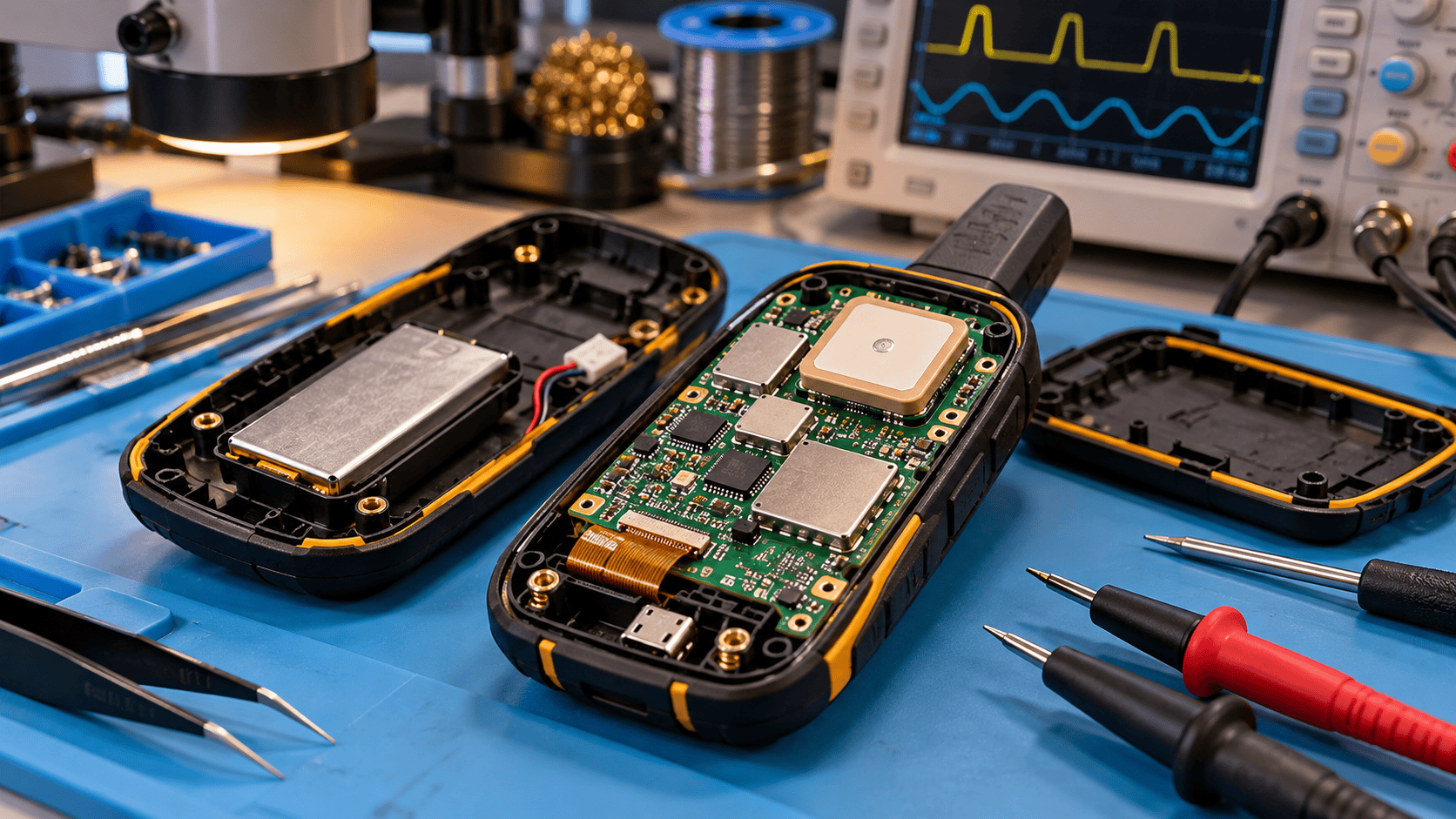
Handheld GPS Receiver Repair in Cornwall: Electronic Fault Assessment
Handheld GPS receivers help walkers, surveyors and outdoor enthusiasts establish their position away from mobile coverage. When a receiver stops acquiring satellites, loses power or behaves unpredictably, replacing it may not be the only option. Cornwall Electronic Repairs can assess suitable standalone handheld GPS navigation equipment, investigate electronic faults and advise whether a practical, cost-effective handheld GPS receiver repair is possible.
A GPS receiver contains more than a screen and a battery. Its internal electronics combine satellite-signal reception, power management, processing, storage and user controls. Identifying which part has failed requires measurements rather than assumptions.
Common Handheld GPS Receiver Faults
Receiver powers on but cannot obtain a satellite fix
A receiver may start normally yet report no satellites, take unusually long to locate its position or lose reception in otherwise suitable outdoor conditions. Potential causes include a damaged antenna connection, a fault in the low-noise radio-frequency (RF) input stage, unstable supply rails or corrupted configuration data. Buildings, terrain, antenna orientation and outdated satellite assistance information can also affect acquisition, so weak reception alone does not prove a hardware defect.
Intermittent operation and unexpected shutdowns
A GPS unit that reboots while recording a route, switches off when moved or behaves differently with external power may have worn battery contacts, an unreliable connector, fractured solder joints or a failing internal power circuit. We can examine suitable accessible assemblies for these faults. Water ingress, impact damage and battery leakage can create several symptoms at once.
Charging, connection and button problems
Rechargeable receivers may fail to charge or communicate through their USB socket. Other models use replaceable cells and have no charging circuitry at all. Our assessment follows the actual equipment design. We can also investigate damaged buttons, corroded contacts and faults affecting the display or backlight where the relevant assemblies are accessible.
How Cornwall Electronic Repairs Can Investigate a GPS Unit
Establish the reported symptoms
We first establish the manufacturer, exact model, power source and circumstances of the fault. We ask whether the problem occurs outdoors with a clear view of the sky, whether batteries have been changed, and whether the unit has suffered a fall or moisture exposure. These details help distinguish environmental or configuration issues from plausible electronic failures.
Inspect power and circuit-board condition
Where opening the unit is appropriate, we can inspect the PCB and connectors under magnification. Particular areas include battery terminals, USB sockets, flex-cable connections, sealing boundaries and components near the power-management circuitry. We may check input protection, continuity, voltage regulators and current consumption using controlled test conditions suited to the unit.
We do not assume a replacement capacitor or regulator will solve every power problem. Measurements must support the suspected failure before any component-level work is proposed.
Investigate satellite reception carefully
GPS signals arriving at the antenna are exceptionally weak. A receiver that fails to acquire satellites may therefore require a different diagnostic approach from a conventional digital circuit fault. Depending on the design and available test access, we can inspect antenna feeds, connectors, RF-stage supply voltages and visible damage around relevant components.
An oscilloscope can help check accessible supply noise and selected digital control signals, but an ordinary bench oscilloscope cannot establish GNSS receiver sensitivity or replace specialist calibrated RF equipment. We would not claim a verified satellite-reception repair without suitable functional evidence. Where precise RF alignment or specialised parts are necessary, referral or replacement may be more appropriate.
Repair Feasibility, Data and Safety
Some handheld units use proprietary sealed assemblies, bonded screens, custom chips or obsolete circuit boards. Opening a weather-resistant case can compromise its original seal, even when the electronic fault is repairable. Replacement gaskets may be unavailable, and a workshop repair cannot automatically restore the manufacturer’s waterproof rating.
Lithium batteries require particular care. Swollen, damaged or overheating cells must not be powered or charged for diagnostic convenience. We will assess whether handling and testing can proceed safely. We also avoid unnecessary resetting or formatting, because stored tracks, waypoints and settings may be important to the owner. Customers should back up accessible data beforehand; preservation and recovery cannot be guaranteed.
Electronic repair may be uneconomical when the unit is inexpensive, heavily corroded or reliant on unavailable proprietary components. The assessment is intended to establish likely fault causes, constraints and the sensible next step, not to promise a successful repair.
What to Provide When Requesting an Assessment
Please include the manufacturer and model, the precise symptoms, any error messages, the type of batteries or external power supply used, and any known history of liquid or impact damage when you contact us. Tell us whether the device still obtains a position outdoors, whether the fault is intermittent and whether stored routes or waypoints need special consideration. Clear photographs can help us decide whether the equipment falls within our assessment capabilities.
Request a Handheld GPS Receiver Assessment in Cornwall
Cornwall Electronic Repairs offers a structured electronic fault assessment for suitable equipment, with further work subject to findings, component availability and customer authorisation. If your standalone handheld GPS receiver has developed a fault, use our Request a Repair form to describe the problem before sending anything to the workshop. We can then advise on the appropriate assessment process and whether investigating the unit is likely to be worthwhile.