
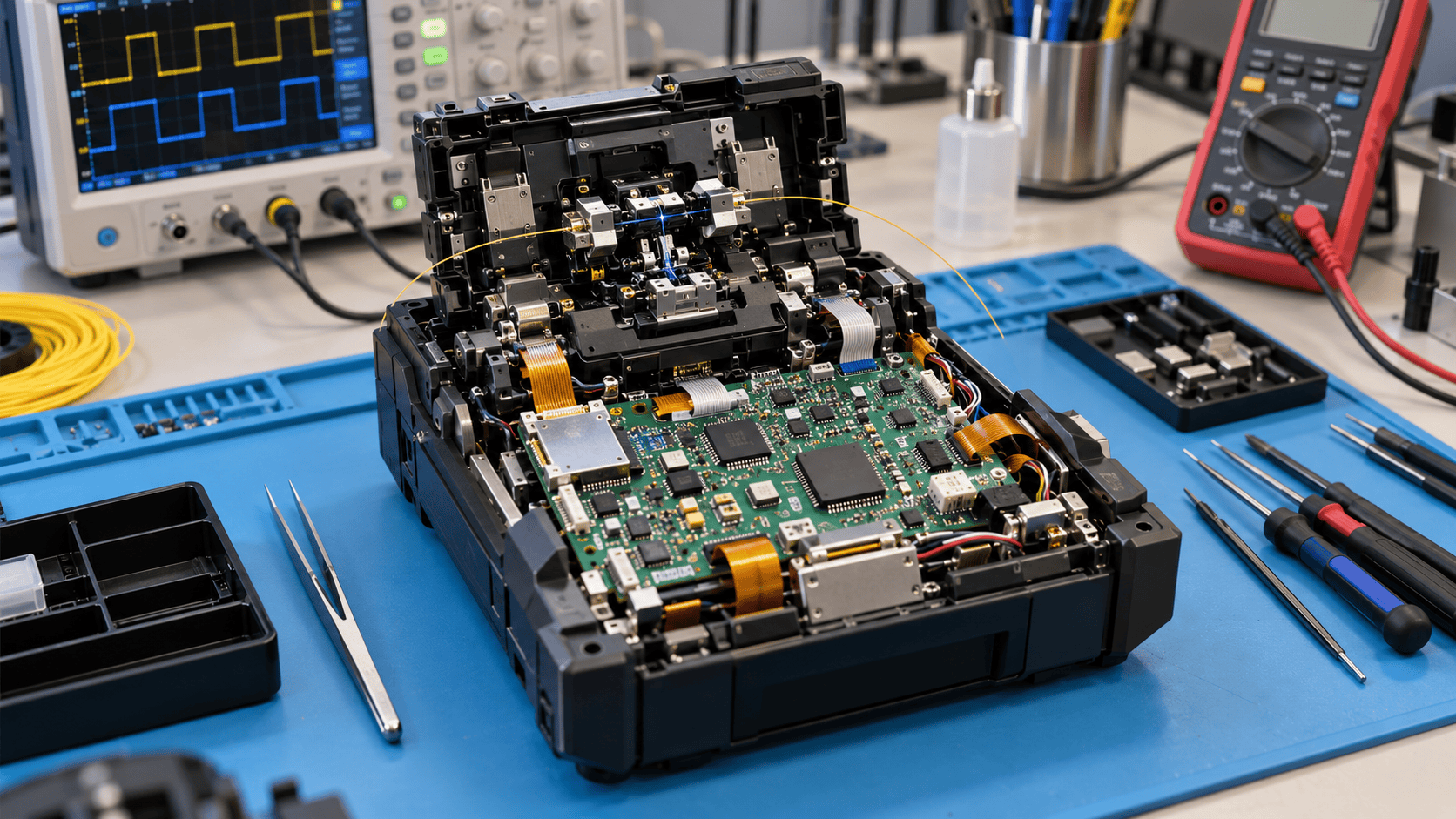
Fibre Optic Fusion Splicer Repair in Cornwall: Electronic Fault Diagnosis and Assessment
When a fusion splicer develops an electronic fault, replacing the complete instrument can be expensive. Cornwall Electronic Repairs (CER) can assess the feasibility of diagnosing and potentially repairing faults within the electronic circuitry of a suitable fibre optic fusion splicer.
Fibre optic fusion splicers are specialist instruments used to join optical fibres with extremely low signal loss. Telecommunications engineers, fibre broadband contractors and industrial network installers depend on these machines to produce reliable connections in demanding working environments.
Our approach focuses on identifying the cause of a fault before recommending component-level repairs, replacement boards or specialist manufacturer support.
How Fibre Optic Fusion Splicers Work
A fusion splicer uses precision alignment mechanisms and a controlled electrical arc to join two prepared optical fibres. Modern instruments combine several electronic systems to achieve accurate, repeatable results.
These typically include:
- Power management and battery charging electronics.
- High-voltage arc-generation circuitry.
- Digital control boards and embedded processors.
- Optical imaging sensors and illumination circuits.
- Stepper motor drivers for fibre alignment.
- Temperature monitoring and electrode control.
- User-interface electronics and communication ports.
A fault in any of these areas may prevent the instrument from operating correctly.
Some faults involve electronic components that CER may be able to investigate. Others involve optical alignment, mechanical accuracy, firmware or calibration systems requiring specialist manufacturer equipment.
Common Fusion Splicer Electronic Faults
Power Supply and Battery Problems
A fusion splicer may fail to start, shut down unexpectedly or operate only from an external power supply.
Potential causes include damaged power connectors, defective voltage regulators, failed protection components, poor solder connections or faults in internal power distribution.
CER can investigate accessible power circuits, measure supply rails and assess whether voltage instability originates within the electronic assembly.
Battery problems require additional care. Lithium-ion battery packs contain protection electronics and can present significant fire risks when damaged. CER would assess battery-related faults without undertaking unsafe cell repairs or bypassing protective circuits.
Arc Generation and Electrode Control Faults
The fusion process requires a precisely controlled electrical discharge between electrodes. Faults in the arc-generation circuitry can cause failed splice attempts, error messages or inconsistent operation.
Depending on the equipment design, electronic investigation may include checking drive signals, control circuitry, feedback paths and associated protection components.
However, arc-generation circuits can produce dangerous high voltages. Testing requires appropriate isolation, discharge procedures and suitable measuring equipment.
CER would not undertake hazardous live measurements where safe access, documentation or the necessary test arrangements are unavailable.
Fibre Alignment and Motor Control Problems
Fusion splicers use miniature motors and precision mechanical assemblies to position optical fibres before joining them.
Electronic faults affecting these systems may produce alignment errors, stalled movement or repeated positioning failures.
Possible investigations include examining motor-driver circuits, connector integrity, control signals and the condition of supporting components.
Mechanical contamination, damaged guides, worn motors or optical misalignment can produce similar symptoms. These problems must be distinguished from electronic defects before any repair decision.
Imaging and Display Electronics
Many fusion splicers use miniature cameras and illumination systems to inspect fibre alignment.
A blank image, intermittent camera feed or illumination failure could involve electronic power supplies, connections or imaging-interface circuitry.
CER may investigate relevant electrical connections and supply voltages where the equipment construction permits access.
Defective camera modules, proprietary image-processing assemblies or alignment-dependent optical components may require specialist replacement and recalibration.
How Cornwall Electronic Repairs Can Assess a Fusion Splicer
Initial Inspection and Fault Investigation
An assessment starts by reviewing the reported symptoms, equipment model, available documentation and relevant fault history.
Depending on the instrument’s condition and accessibility, CER may undertake:
- Visual inspection for contamination, corrosion, damaged connectors and overheating.
- Continuity and resistance testing of suitable unpowered circuits.
- Inspection of solder joints and accessible PCB assemblies.
- Evaluation of power distribution and voltage regulation.
- Component-level testing of suspected semiconductors and passive components.
- Examination of motor-control and sensor-interface electronics.
- Controlled electrical testing where safe and technically appropriate.
Our electronic test equipment can help identify failed components, unstable voltages, abnormal signals and intermittent connections.
A repair recommendation depends on the evidence obtained during assessment rather than assumptions about the reported symptoms.
Component-Level Repair Possibilities
Where faults involve accessible and replaceable electronic components, CER may be able to undertake targeted PCB repairs.
Examples include replacing suitable regulators, capacitors, protection devices or damaged connectors, and reworking confirmed defective solder joints.
Repair feasibility depends on component availability, PCB condition, circuit complexity and the ability to test the instrument afterwards.
Proprietary integrated circuits, encrypted electronics, multilayer PCB damage or unavailable replacement parts can make repair impractical.
Safety, Calibration and Repair Limitations
Fusion splicers combine high-voltage arc generation, lithium-ion batteries, delicate optical components and precision mechanical alignment.
Electronic functionality alone does not establish that an instrument can produce acceptable optical splices.
Following electronic repair, a fusion splicer may require electrode conditioning, arc calibration, alignment verification and optical loss testing using manufacturer-approved procedures.
CER does not represent a component-level repair as a substitute for specialist optical calibration or manufacturer certification.
We would also consider whether the instrument can be safely reassembled and whether sufficient functional verification is possible before recommending further work.
Is Fusion Splicer Repair Economically Worthwhile?
Professional fusion splicers can represent a substantial investment, making fault assessment potentially worthwhile when the alternative is complete replacement.
However, repair costs depend on the instrument’s age, fault severity, parts availability and test requirements.
An older machine with an isolated power-supply defect may present a different repair prospect from one requiring proprietary optical modules or extensive mechanical recalibration.
CER provides an initial electronic assessment for £40, with any further investigation or repair discussed before additional work proceeds.
An assessment does not guarantee that an economical or technically viable repair will be possible.
Request a Fibre Optic Fusion Splicer Assessment in Cornwall
If your fibre optic fusion splicer has developed a suspected electronic fault, Cornwall Electronic Repairs can review the symptoms and advise whether an assessment is appropriate.
Please provide the manufacturer, model, reported error messages, power behaviour and any known damage or repair history.
Use our Request a Repair page to submit an enquiry.
We can then consider whether the equipment is suitable for electronic fault investigation, or whether specialist manufacturer service would be the more appropriate route.