
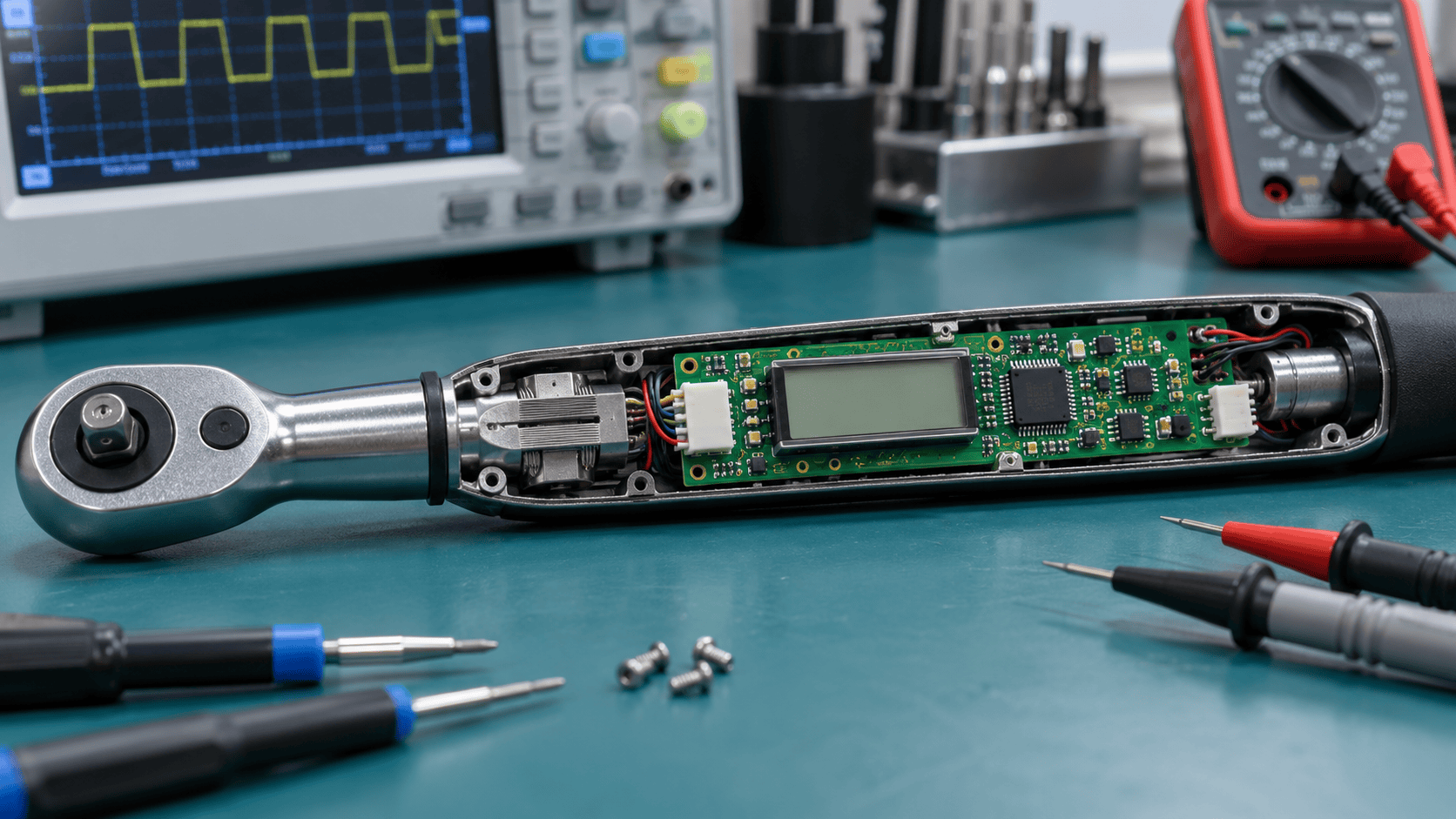
Digital Torque Wrench Electronics Repair in Cornwall
Cornwall Electronic Repairs can assess the electronic assemblies within suitable digital torque wrenches, investigate faults and discuss whether component-level work is practical. We focus on electronic diagnosis rather than mechanical torque adjustment or certified calibration. Because incorrect torque readings can affect safety, any repaired measuring instrument must be checked appropriately before returning to critical service.
Digital torque wrenches merge precision mechanics with electronics. When a wrench fails or loses reliability, the issue often stems from its circuitry rather than the mechanical drive.
How a Digital Torque Wrench Works
A typical electronic torque wrench uses a strain-sensitive measurement element to detect small changes as force is applied. The signal passes through analogue conditioning circuitry before a microcontroller converts it into a displayed value. Depending on the model, the wrench may also use a buzzer, vibration motor or indicator lights to tell the operator when a target setting has been reached.
Some designs include an angle-measurement sensor, memory, wireless communications or a rechargeable battery. The electronics often occupy a narrow housing where flexing, impacts and battery leakage can create problems over time.
Electronic Faults We Can Investigate
No Power or an Intermittent Display
An apparently dead wrench may have corroded battery contacts, a damaged switch, an open circuit in the supply path or a failed voltage regulator. We can inspect accessible connections and measure supply rails under controlled conditions. Where the display works only intermittently, we may also investigate ribbon connections, solder joints and PCB damage.
Unstable or Implausible Torque Readings
A drifting zero point, readings that jump without applied torque or values that remain fixed can indicate problems with the sensor interface. Potential causes include compromised strain-gauge connections, unstable analogue reference voltages, damaged filtering components or faults in the analogue-to-digital conversion path.
These symptoms do not prove an electronic defect. Since mechanical damage or calibration loss can cause similar issues, diagnosis must separate the electronics from the measuring mechanism.
Missing Audible, Visual or Vibration Alerts
If the wrench displays a reading but provides no target-torque warning, the problem may lie in a buzzer, vibration actuator, driver transistor, connection or related control circuitry. We can evaluate these accessible electronic functions where testing can be conducted without imposing unsafe mechanical loads.
Charging and Communication Problems
On models with rechargeable batteries or digital interfaces, we may investigate damaged charge sockets, charging-control circuitry, connector faults and accessible communications hardware. Battery condition, proprietary firmware, unavailable components and sealed construction can limit the work we can undertake.
Our Electronic Assessment Process
We begin with the exact manufacturer and model, the reported symptoms and any history of impact, liquid exposure or previous repair attempts. Photos of the display, battery compartment and external connectors are helpful at the enquiry stage.
For suitable units, we evaluate construction and non-destructive access. When appropriate, we magnify the PCB, monitor power, check regulated voltages, and test accessible switches, connectors, and outputs.
Where the circuitry permits, an oscilloscope can help investigate noisy supply rails, intermittent signals or sensor-conditioning stages. We avoid applying arbitrary electrical signals to an unknown measurement input, since an incorrect stimulus can damage sensitive analogue circuitry or invalidate the instrument’s behaviour.
Our findings help establish whether a defined electronic defect can be repaired economically, whether specialist mechanical work is needed, or whether replacement is the more sensible option. We explain the position before requesting authorisation for additional repair work.
Calibration, Safety and Practical Limitations
A digital torque wrench is a measuring tool. Repairing a power supply, connector or display does not establish that its torque readings are accurate. Even if it appears to operate normally afterwards, accuracy and repeatability must be verified using suitable calibrated torque-testing equipment and the manufacturer’s procedure.
Cornwall Electronic Repairs does not provide certified torque calibration. For safety-critical, structural, or high-consequence applications, customers must arrange independent calibration before use.
We may decline units with inaccessible encapsulated electronics, severely damaged strain elements, unavailable proprietary parts or construction that cannot be opened without impairing safety or measurement integrity. Assessment may also show that repair would cost more than a replacement instrument.
Request an Assessment in Cornwall
If your digital torque wrench has a power, display, warning or electronic measurement fault, tell us the make and model and describe exactly what happens. Please mention any drop, moisture ingress, battery leakage or previous attempt to repair it.
Use our Request a Repair form to send an enquiry. Cornwall Electronic Repairs can review the information, advise whether an electronic assessment is appropriate and outline the next steps. Assessment and any further work are subject to agreement; repair is not guaranteed.