
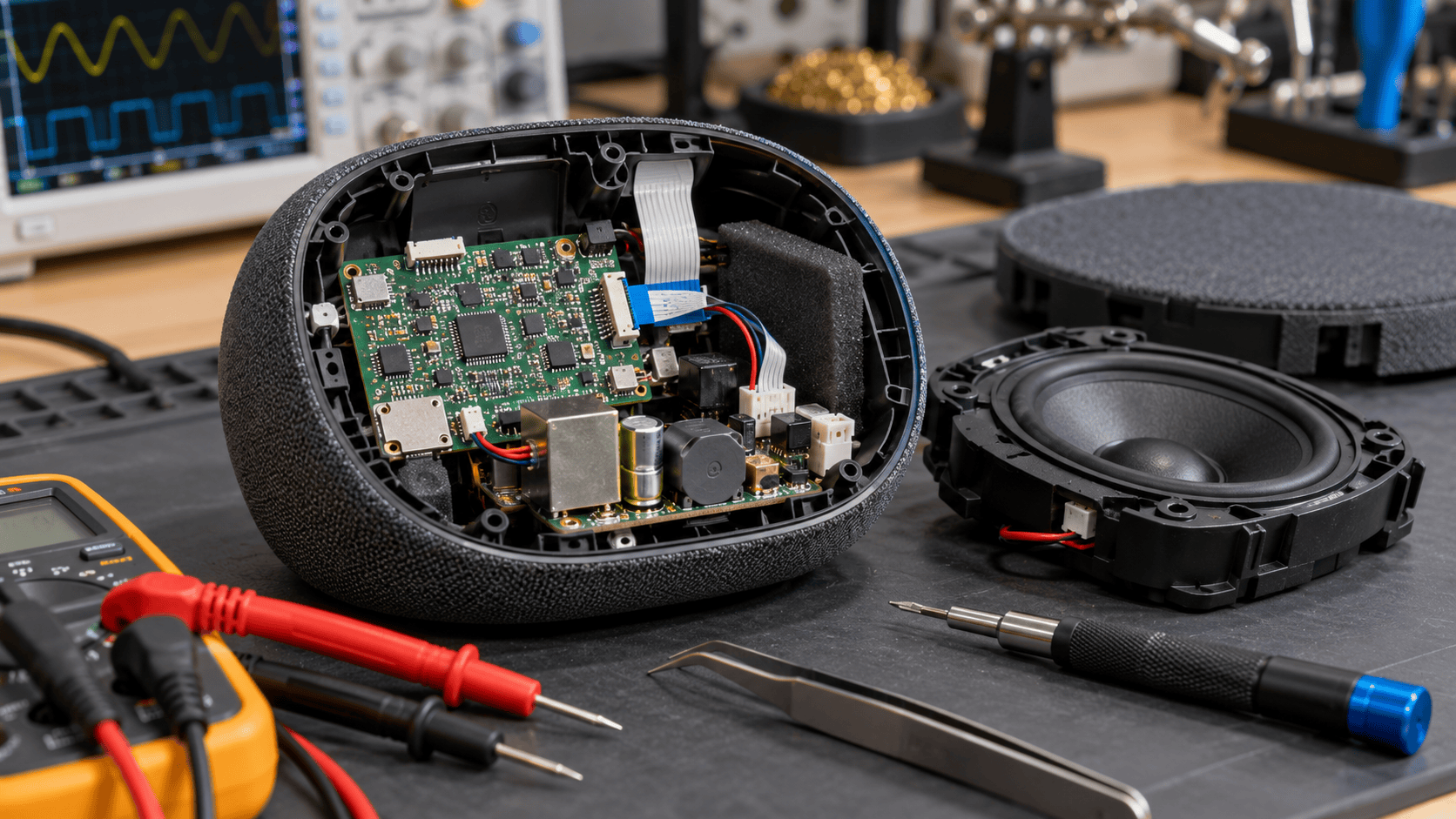
Smart Speaker PCB Repair in Cornwall: Fault Diagnosis and Assessment
Smart speakers combine wireless networking, digital processing, microphones, amplification and power management inside compact enclosures. When one stops responding, the cause may sit on its circuit board rather than in the loudspeaker itself. Cornwall Electronic Repairs can assess suitable smart speaker PCBs, investigate electronic faults and discuss whether a component-level repair makes practical sense.
We focus on the electronics, not cloud account recovery, voice assistant subscriptions or unsupported software modifications. An assessment starts with the model, its symptoms and the condition of the equipment.
Which smart speaker faults can we investigate?
A speaker that appears completely dead may have a defective power adaptor, damaged DC input, protection device or internal voltage regulator. Others illuminate briefly, restart repeatedly or become unresponsive after warming up. These symptoms can point towards unstable supply rails, connector problems or faults elsewhere on the PCB.
We can also consider speakers that power on but produce no sound, exhibit distortion or respond intermittently to physical controls. Depending on the design, investigation may cover the amplifier stage, signal paths, ribbon cables, tactile switches and associated supply circuits.
Microphone or wireless problems need more caution. A failed microphone supply or damaged antenna connector may have an identifiable hardware cause. However, pairing failures, network authentication problems and voice assistant errors may originate in firmware, configuration or an external service. PCB repair cannot resolve every such problem.
How we approach smart speaker PCB diagnosis
Initial inspection and power checks
We first examine the external condition, power connections and any evidence of liquid ingress, impact damage or previous repair attempts. If a manufacturer uses an external low-voltage adaptor, we can check its output under appropriate conditions before blaming the speaker.
After safe disassembly, visual inspection may reveal cracked solder joints, corroded connections, overheated components or damaged connectors. Some enclosures rely on adhesive, clips and acoustic seals. Opening them can damage cosmetic parts or reduce their original environmental protection, so we assess access risks before proceeding.
Measurements on the circuit board
Where access and documentation permit, we may check for short circuits, measure supply rails and investigate the operation of voltage regulators. Current-limited power, multimeter measurements and oscilloscope checks can help identify an abnormal electrical condition without replacing components at random.
For example, a speaker that continually restarts may warrant checks for supply voltage collapse during boot. A silent speaker may require examination of its amplifier supply and output circuitry. Neither symptom proves that a particular integrated circuit has failed; the test results must guide that conclusion.
Surface-mount components often sit close together on multilayer boards. We use suitable inspection and rework methods where the layout allows them, while recognising that microscopic damage beneath packaged devices may remain inaccessible.
Repair decision and controlled testing
If testing identifies a replaceable faulty component, we can assess the availability of an equivalent part and the feasibility of repair. Candidate work might include restoring a damaged power connector, replacing a failed regulator or addressing a localised soldering defect. We only recommend work when the evidence and likely cost justify it.
After any authorised electronic work, we would check relevant voltages and basic operating behaviour. Full functional verification may also require the owner’s compatible app, network, account or supported online service. We will explain any test coverage we cannot provide.
Important limitations with connected speakers
Modern smart speakers often use proprietary system-on-chip devices, encrypted storage, secure boot mechanisms and tightly integrated wireless modules. These parts may lack service documentation or commercially available replacements. A fault involving firmware corruption, security provisioning or a locked device may therefore prevent an economical repair.
We do not bypass account security, defeat access controls or offer to recover third-party credentials. A factory reset may erase settings and will not correct defective electronics. Owners should remove personal associations or follow the manufacturer’s transfer instructions where appropriate, without sharing passwords.
Lithium-ion batteries in portable smart speakers introduce further hazards. A swollen, punctured or overheating battery needs specialist handling, and we may decline equipment that cannot be transported or examined safely. Mains-powered designs can also contain hazardous voltages even after disconnection; qualified checks and appropriate isolation procedures remain essential.
Is smart speaker repair financially worthwhile?
The answer depends on the speaker’s value, accessibility, fault complexity and replacement parts. A modestly priced unit with a failed proprietary processor may cost more to investigate than to replace. A higher-value model with a clear power input or regulator fault could justify further assessment, subject to parts and test access.
Cornwall Electronic Repairs charges a standard £40 assessment fee. We would report our findings, explain limitations and seek authorisation before undertaking additional chargeable repair work. Assessment does not guarantee a repair outcome, and some equipment may prove uneconomical or impossible to restore.
Request a smart speaker assessment
If your smart speaker no longer starts, repeatedly restarts or has a suspected electronic fault, send us its make and model, power supply details, symptoms and any history of damage or previous work. Photographs can help us evaluate whether inspection looks feasible. We welcome suitable enquiries from Cornwall and elsewhere in the UK, including equipment that customers can send by post following our instructions.
Please take a moment to request a comprehensive repair assessment today, and our team of experienced professionals will carefully review all the provided information before directly advising you on the absolute best next step to take using this Request a repair assessment link.