
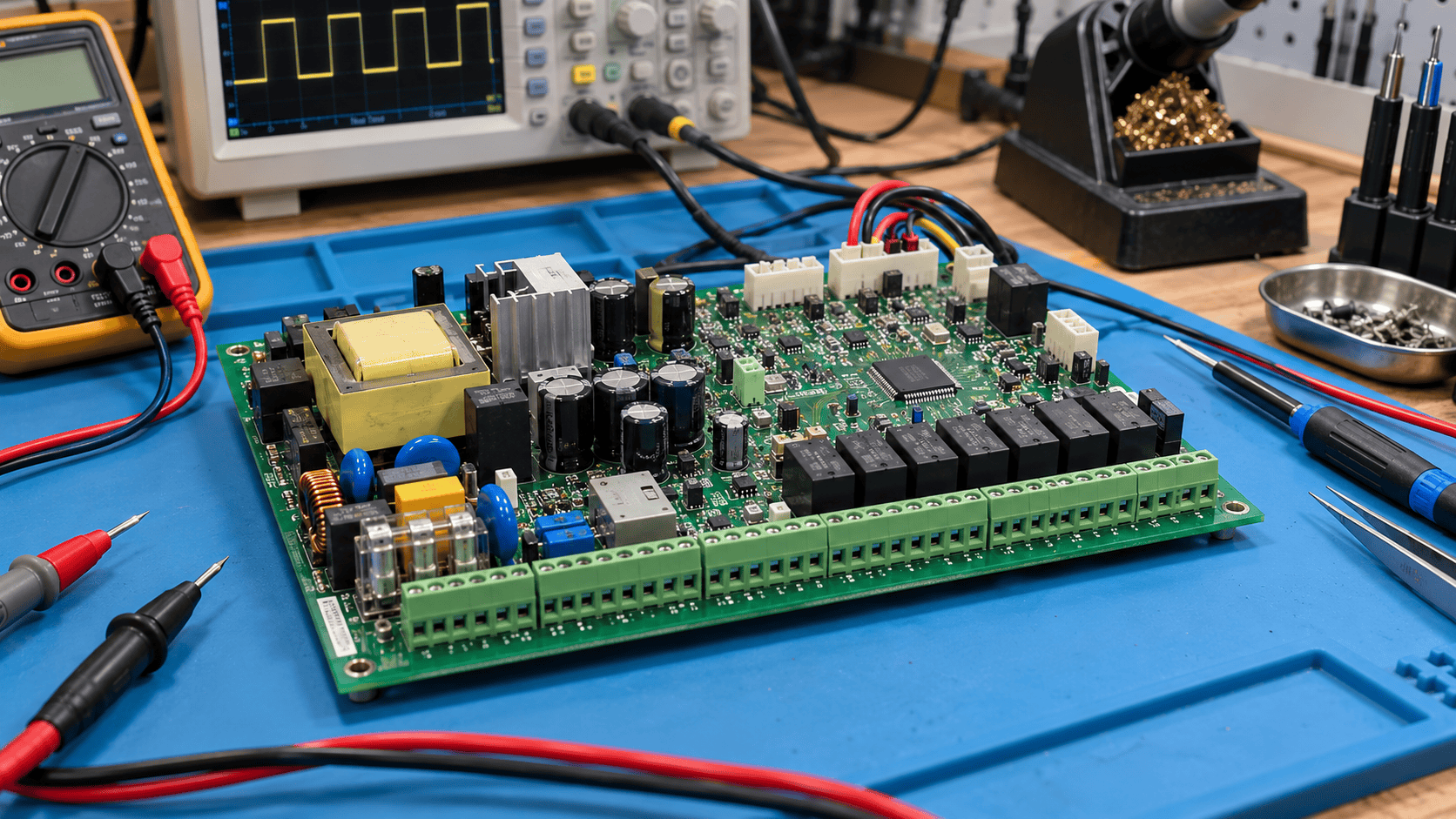
Security Alarm Control Panel PCB Repair in Cornwall
An intruder alarm control panel relies on electronic circuitry to supervise detectors, monitor tamper inputs, manage its standby battery and operate sounders. When that circuitry fails, replacing the entire alarm system may not be the only option. Cornwall Electronic Repairs can assess suitable alarm control panel PCBs, investigate electronic faults and determine whether a component-level repair is technically and economically viable.
Our work focuses on the electronics inside the panel, rather than installing alarm systems, bypassing protection or certifying site security. Any repaired equipment must undergo appropriate checks by the responsible alarm installer before returning to service.
Common Signs of Alarm Control Panel Electronics Problems
A failing panel may appear completely dead, restart unexpectedly or display fault indications that do not match the actual condition of its connected equipment. Some panels may struggle to charge or maintain the standby battery. Others may have damaged terminals, unreliable keypad communications or an output that fails to operate as intended.
These symptoms do not automatically prove that the PCB is defective. Cabling, detectors, sounders, batteries, power supplies and configuration can produce similar behaviour. Establishing whether the fault follows the board is an important first step.
What Can We Assess on an Alarm Panel PCB?
Power Supply and Battery Charging Circuits
Many alarm panels use a mains-fed power supply together with a rechargeable standby battery. With the board safely isolated and the circuit understood, we can inspect the low-voltage supply stages, rectification, voltage regulation, protective components and charging circuitry. Measurements may reveal missing supply rails, excessive ripple, abnormal current draw or evidence of overheating.
Battery failure does not necessarily indicate a charging fault. An aged battery, a defective external transformer or poor connections may be responsible. The correct battery chemistry, ratings and manufacturer requirements must be established before any charging-circuit conclusions are drawn.
Input, Output and Communication Electronics
Depending on the design, an alarm PCB may contain protected sensing inputs, relay or transistor outputs, serial interfaces and connectors for keypads or expansion modules. We can examine suspect electronic stages for damaged components, fractured solder joints, corroded connections and other measurable defects.
Testing concentrates on electrical behaviour rather than defeating alarm functionality. Some faults require compatible peripherals, proprietary documentation or manufacturer-specific test procedures. Without these resources, complete functional confirmation may not be possible.
Ageing Components and Physical Damage
Electrolytic capacitors, voltage regulators, protection devices and connectors can deteriorate over time. Moisture ingress, previous repairs, impact or prolonged heat can also damage copper tracks and solder joints. Under magnification, we can inspect the PCB and use appropriate instruments to check suspected components.
Not every discoloured component is faulty, and not every fault leaves visible evidence. Diagnostic measurements help distinguish a genuine defect from normal ageing or operating temperatures.
How Our Fault Assessment Works
We begin by reviewing the panel make and model, reported symptoms, any relevant fault indications and what has already been tested. Clear photographs of the board and its labels can help us assess suitability before equipment is sent.
Once an assessment is authorised, we inspect the electronics and select tests that suit the particular circuit. These may include continuity and resistance checks on an unpowered board, semiconductor and capacitor testing, or controlled low-voltage measurements where safe and practical. An oscilloscope may help investigate unstable supplies or communications at accessible points.
We do not assume that a panel is safe to power simply because it looks intact. Mains-connected sections and battery-backed circuits require particular care. Testing may remain limited if safe power arrangements, circuit information or suitable peripherals are unavailable.
Following assessment, we explain the findings, the likely repair approach where one exists, and any significant uncertainty. We seek authorisation before proceeding with additional repair work.
Safety, Security and Repair Limitations
An alarm panel is part of a security system, so electrical repair alone cannot demonstrate that the installed system provides adequate protection. We do not provide alarm bypass instructions, security-code recovery, programming changes, monitoring-service configuration or certification of compliance with applicable alarm standards.
The system should be decommissioned and disconnected by a competent person before the PCB is removed. Where relevant, the installer or monitoring provider must manage notifications and prevent unwanted alarm activations. Never expose mains terminals or disconnect a standby battery without following the manufacturer’s safe procedure.
After any electronic repair, a qualified alarm professional should reinstall the unit and verify detector zones, tamper circuits, sounders, battery operation, signalling, event reporting and the complete system configuration. Insurer, monitoring-provider and manufacturer requirements may also affect whether an older panel can return to service.
When Is PCB Repair Worth Considering?
Repair may be attractive for an older or discontinued alarm panel when the fault is localised and a compatible replacement board is difficult to obtain. However, damaged processors, unavailable programmed devices, multilayer PCB damage or proprietary modules may make repair impractical.
We also consider parts availability, diagnostic time, replacement-system costs and the risk that further faults remain hidden. Our standard assessment fee is £40, and a repair quotation or recommendation follows the findings. We cannot guarantee that every board is repairable or that a repaired panel can be recommissioned.
Ask Cornwall Electronic Repairs About Your Alarm PCB
If you have an intruder alarm control panel with a suspected electronic fault, send us the make, model, symptoms and clear board photographs. Please confirm whether a competent installer can isolate the system and carry out post-repair testing.
Request a repair assessment and we can advise whether the PCB is suitable for investigation before you arrange delivery.