
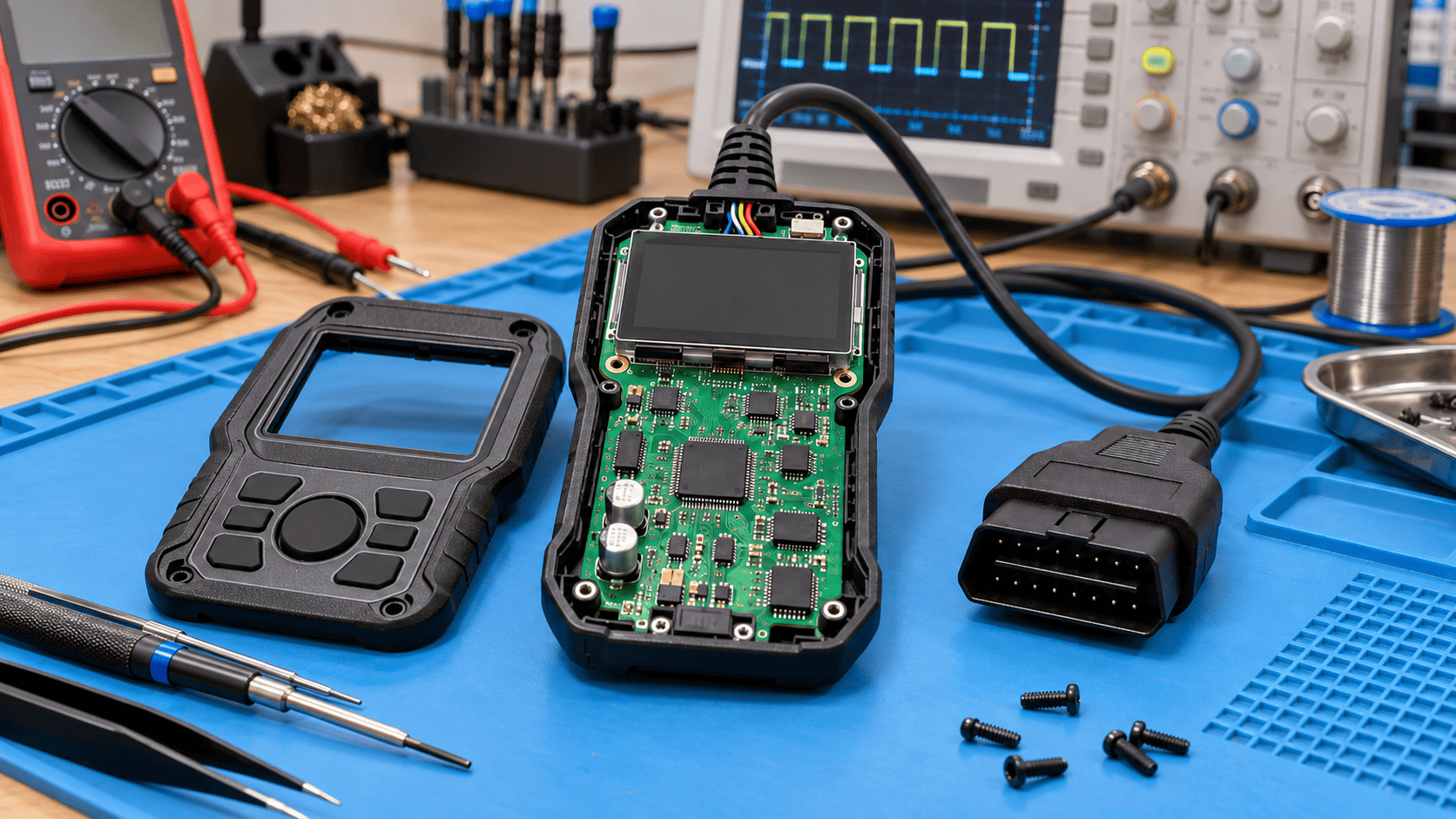
OBD-II Vehicle Diagnostic Scanner Repair in Cornwall
An OBD-II scanner can quickly diagnose vehicle faults, but the tool itself may eventually fail. A damaged connector, unstable power, or a broken display can render a useful device completely unusable.
Cornwall Electronic Repairs can assess the electronic hardware inside suitable handheld vehicle diagnostic scanners and investigate whether a practical repair is possible. Our focus is on electronic fault diagnosis and component-level work, rather than vehicle servicing, immobiliser programming, or changes to a vehicle’s control units.
What Is Inside an OBD-II Diagnostic Scanner?
A handheld scanner features more than just a screen and cable. Depending on the model, it typically houses a processor, voltage regulators, communication transceivers, protective components, memory, keypad electronics, and a display interface.
Many scanners receive power through the vehicle’s 16-pin diagnostic socket. Others use an internal battery, USB supply or separate adaptor. These different arrangements matter because the correct diagnostic procedure depends on how the instrument was designed to operate.
We can investigate appropriate accessible circuits, subject to the availability of service information, replacement components and safe testing arrangements.
Common Scanner Faults Worth Investigating
Scanner Does Not Power Up
A scanner that remains completely dead may have a damaged cable, faulty power input, failed protective component or problem within its voltage regulation stage. The absence of a display does not necessarily mean the processor has failed.
An assessment can start with visual inspection and continuity checks, followed by controlled measurements of supply rails where the circuit design permits. Any abnormal current consumption may help narrow down the investigation.
Intermittent Power or Communication
Repeated restarts, intermittent connection to the vehicle or an unreliable diagnostic link can arise from worn connectors, cable damage, fractured solder joints or other electronic faults. However, a communication failure may also involve the vehicle, its diagnostic socket, incompatible protocols or software.
We would distinguish a reproducible hardware problem from an issue that depends on a particular vehicle before recommending repair work. Where available, an appropriate interface simulator or known-good test arrangement may support further checks.
Buttons, Display and USB Faults
Failed keypads, damaged display connectors and unreliable USB sockets are other possible areas for assessment. Some defects can be traced to physical wear or solder connection problems, while others involve proprietary components that cannot be sourced economically.
We can inspect the relevant assemblies and evaluate whether the affected part can be repaired or replaced without damaging adjacent circuitry.
How We Approach Electronic Fault Diagnosis
Initial Inspection and Electrical Checks
We begin by reviewing the symptoms, the scanner’s make and model, how it is powered and whether the failure occurs consistently. Photographs of the diagnostic connector, cable and equipment can help establish the likely scope before the unit arrives.
Once authorised, assessment may involve magnified inspection, checking for contamination or damage, testing continuity, and examining power and regulation circuits. An oscilloscope can also help identify unstable voltages or missing signals.
Measurements are selected to suit the particular PCB. We do not assume every scanner has the same architecture or that a single test will confirm the fault.
Component-Level Repair Possibilities
If investigation identifies a defective, accessible component, repair might involve replacing a socket, protective device, regulator or other obtainable part. We may also address damaged solder joints or localised PCB connection problems where the board remains structurally sound.
Before carrying out further work, we consider replacement-part availability, labour time, the value of the scanner and the likelihood of a reliable result. An assessment may conclude that replacement is more economical.
Safety, Compatibility and Repair Limitations
Vehicle diagnostic connectors can carry battery voltage, and vehicle electrical systems can produce transient disturbances. We use suitable controlled test arrangements rather than making unsupported assumptions about a scanner’s power and signal connections.
Repairing hardware does not guarantee compatibility with every vehicle or restore a manufacturer’s subscription, licensed software, firmware access or online functions. We cannot guarantee recovery of corrupted proprietary firmware or replace security-locked components without legitimate manufacturer support.
Cornwall Electronic Repairs excludes vehicle ECU coding, key programming, immobiliser bypasses, and emissions modifications. Post-repair testing may still require specific equipment, licensed software, or compatible vehicles unavailable in our workshop.
Request an Assessment in Cornwall
If your OBD-II scanner has a suspected electronic fault, please provide its manufacturer, exact model, symptoms and clear photographs. Tell us whether the problem affects power, controls, display, USB or vehicle communication, and include details of any previous damage or attempted repair.
Our standard assessment fee is £40. We explain the findings and any proposed further work before asking you to authorise additional repair costs. Not every device can be repaired, and an assessment does not guarantee a successful outcome.
To discuss your equipment, submit a repair enquiry.